Back

Acid-Base Indicators quiz

Control buttons has been changed to "navigation" mode.
1/15
  • What is an acid-base indicator?

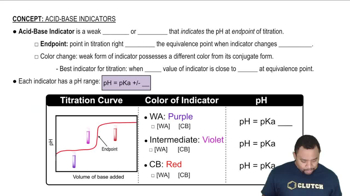
    An acid-base indicator is a weak acid or weak base that changes color at a specific pH, signaling the endpoint of a titration.
  • What is the endpoint in a titration?

    The endpoint is the point just after the equivalence point when the indicator changes color.
  • How does an indicator signal the endpoint of a titration?

    It signals the endpoint by changing color when the weak form of the indicator is converted to its conjugate form.
  • Why does the color of an indicator change during a titration?

    The color changes because the indicator shifts between its weak acid (or base) form and its conjugate form, each having a different color.
  • What is the ideal pKa value for an indicator used in a titration?

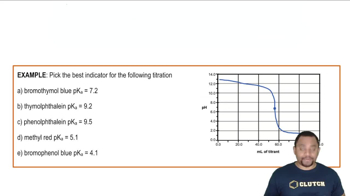
    The ideal indicator has a pKa value close to the pH at the equivalence point of the titration.
  • What is the typical pH range over which an indicator changes color?

    An indicator usually changes color within one pH unit above and below its pKa (pKa ± 1).
  • What color change does methyl orange undergo and over what pH range?

    Methyl orange changes from red to yellow over a pH range of 3.3 to 4.5.
  • How does the concentration of weak acid and conjugate base relate to the indicator's color at the endpoint?

    At the endpoint, the concentrations of the weak acid and its conjugate base are approximately equal, resulting in an intermediate color.
  • What is the relationship between pH and pKa at the start, midpoint, and end of an indicator's color change?

    At the start, pH = pKa - 1; at the midpoint (endpoint), pH = pKa; at the end, pH = pKa + 1.
  • What happens to the indicator's color when the weak acid form is greater than the conjugate base form?

    The solution shows the color of the weak acid form, which is the initial color before the endpoint.
  • What color is observed when the conjugate base form of the indicator predominates?

    The solution shows the color of the conjugate base form, which is the final color after the endpoint.
  • Why is it important to choose an indicator with a pKa close to the equivalence point pH?

    This ensures the indicator changes color at the right moment, accurately signaling the endpoint of the titration.
  • What is unique about thymol blue as an indicator?

    Thymol blue has two pH transition ranges (1.2–2.8 and 8–9.2) and can change from red to yellow and then from yellow to blue.
  • Do you need to memorize the names and ranges of all common indicators?

    No, you do not need to memorize them, but you should understand how indicators work and their general properties.
  • How does the color at the midpoint of the indicator's transition relate to the starting and ending colors?

    The midpoint color is often an average or mix of the starting and ending colors, reflecting equal concentrations of the weak acid and conjugate base forms.