Back

Acids Introduction quiz

Control buttons has been changed to "navigation" mode.
1/15
  • What is the general composition of acids as covalent compounds?

    Acids are covalent compounds with a hydrogen ion connected to a nonmetal anion or a polyatomic ion.
  • Where is the hydrogen ion typically located in acid formulas?

    The hydrogen ion is usually at the beginning of the compound, except in cases like acetic acid and positive amines.
  • What is an anion?

    An anion is a negatively charged ion.
  • How is acetic acid commonly written, and where is the hydrogen located?

    Acetic acid is written as CH3COOH, with the hydrogen at the end, or as HC2H3O2, with hydrogen at the beginning.
  • What makes an amine acidic?

    An amine is acidic if it is positively charged, such as the ammonium ion (NH4+).
  • What elements are found in amines?

    Amines contain nitrogen and hydrogen, or carbon, nitrogen, and hydrogen.
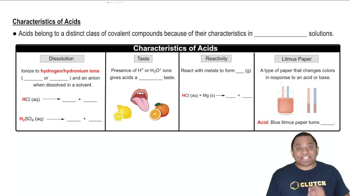
  • What happens when acids dissolve in water?

    Acids ionize into hydrogen (H+) or hydronium (H3O+) ions and an anion in aqueous solutions.
  • What ions are produced when hydrochloric acid (HCl) dissolves in water?

    Hydrochloric acid produces H+ and Cl- ions in aqueous solution.
  • How does sulfuric acid (H2SO4) ionize in water?

    Sulfuric acid can ionize to produce 2 H+ ions and a sulfate ion (SO4^2-) in aqueous solution.
  • What taste is characteristic of acids?

    Acids have a sour taste due to the presence of H+ or H3O+ ions.
  • How do acids react with metals?

    Acids react with metals to produce hydrogen gas (H2).
  • What is a common experiment demonstrating acid reactivity with metals?

    Reacting hydrochloric acid with magnesium produces hydrogen gas and magnesium chloride.
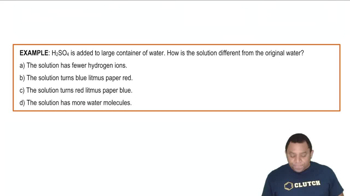
  • What effect do acids have on blue litmus paper?

    Acids turn blue litmus paper red.
  • What is litmus paper used for in chemistry?

    Litmus paper is used to detect acids and bases by changing color in their presence.
  • Why is understanding acid characteristics important?

    Understanding acid characteristics helps recognize and predict their behavior in chemical contexts.