Atomic Mass quiz #2 Flashcards

Atomic Mass quiz #2
Control buttons has been changed to "navigation" mode.
1/40
  • What is the atomic mass for carbon?
    The atomic mass for carbon is approximately 12.01 amu.
  • What is the atomic mass of magnesium?
    The atomic mass of magnesium is approximately 24.31 amu.
  • Which element has the largest atomic mass?
    Oganesson (Og) has the largest atomic mass among known elements.
  • What is the atomic mass of lithium?
    The atomic mass of lithium is approximately 6.94 amu.
  • How many protons are in silver?
    Silver has 47 protons.
  • What is the atomic mass of nickel?
    The atomic mass of nickel is approximately 58.69 amu.
  • What is the atomic mass of manganese?
    The atomic mass of manganese is approximately 54.94 amu.
  • If oxygen has an atomic weight of 16, what does this mean?
    It means the average atomic mass of oxygen is 16 amu, accounting for its isotopes.
  • What is the atomic mass of zinc?
    The atomic mass of zinc is approximately 65.38 amu.
  • Which is true concerning atomic weight?
    Atomic weight is the weighted average mass of an element's isotopes.
  • Which property of an element is determined by adding the number of protons and number of neutrons?
    The mass number is determined by adding the number of protons and neutrons.
  • Which correctly determines an atom’s identity and chemical properties?
    The atomic number (number of protons) determines an atom’s identity and chemical properties.
  • What is the atomic mass of the isotope of manganese (Mn) containing 28 neutrons?
    The atomic mass is approximately 53 amu (25 protons + 28 neutrons).
  • What is the symbol of this atom? Enter both the mass and the atomic number.
    The symbol is written as: Element symbol, mass number (top left), atomic number (bottom left).
  • What is the average atomic mass of gallium?
    The average atomic mass of gallium is approximately 69.72 amu.
  • What is the approximate atomic mass of an atom with 16 neutrons?
    If the atom is sulfur (16 protons), the atomic mass is about 32 amu.
  • What is the atomic mass of mercury?
    The atomic mass of mercury is approximately 200.59 amu.
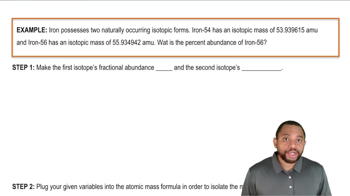
  • Lithium-6 is 4% abundant and lithium-7 is 96% abundant. What is the average mass of lithium?
    Average mass = (0.04 × 6) + (0.96 × 7) = 6.96 amu.
  • How is the atomic mass unit (amu) defined?
    1 amu is defined as 1/12 the mass of a carbon-12 atom, or 1.66 × 10⁻²⁷ kg.
  • What does it mean if the atomic mass is 10.8?
    It means the weighted average mass of the element's isotopes is 10.8 amu.
  • What is the atomic mass of xenon?
    The atomic mass of xenon is approximately 131.29 amu.
  • What is the atomic mass of phosphorus?
    The atomic mass of phosphorus is approximately 30.97 amu.
  • Which numerical setup can be used to determine the atomic mass of bromine?
    Atomic mass = (isotope 1 mass × fractional abundance) + (isotope 2 mass × fractional abundance).
  • What is the atomic mass of beryllium?
    The atomic mass of beryllium is approximately 9.01 amu.
  • What is the atomic mass of krypton?
    The atomic mass of krypton is approximately 83.80 amu.
  • What makes up the atomic mass?
    Atomic mass is made up of the masses of protons, neutrons, and electrons.
  • What is the atomic mass of copper?
    The atomic mass of copper is approximately 63.55 amu.
  • Which of the following properties uniquely identifies every element?
    The atomic number uniquely identifies every element.
  • What is the atomic mass of a boron atom that has 6 neutrons?
    The atomic mass is approximately 11 amu (5 protons + 6 neutrons).
  • Which has a greater mass: a proton or a neutron?
    A neutron has a slightly greater mass than a proton.
  • The average atomic mass of aluminum is 26.98 amu. What is true about the mass of aluminum atoms?
    Individual aluminum atoms may have masses close to 27 amu, but the average is 26.98 amu due to isotopes.
  • What is the atomic mass of the element fluorine?
    The atomic mass of fluorine is approximately 18.998 amu.
  • What is the atomic mass for fluorine?
    The atomic mass for fluorine is approximately 18.998 amu.
  • What is the difference between atomic number and atomic mass?
    Atomic number is the number of protons; atomic mass is the weighted average mass of isotopes.
  • Which one of the following is the largest mass: proton, neutron, electron, or atom?
    An atom has the largest mass among these choices.
  • What is the atomic mass of platinum?
    The atomic mass of platinum is approximately 195.08 amu.
  • What is the mass number for an atom of barium containing 56 protons and 78 neutrons?
    The mass number is 134 (56 + 78).
  • What is the difference between mass number and atomic mass?
    Mass number is the total number of protons and neutrons; atomic mass is the weighted average mass of isotopes.
  • What is the average atomic mass of bromine?
    The average atomic mass of bromine is approximately 79.90 amu.
  • What is the atomic mass of argon?
    The atomic mass of argon is approximately 39.95 amu.