Back

Atomic, Ionic, and Molecular Solids quiz

Control buttons has been changed to "navigation" mode.
1/15
  • What is the main difference between crystalline and amorphous solids?

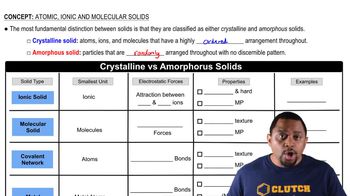
    Crystalline solids have highly ordered arrangements of particles, while amorphous solids have randomly arranged particles with no discernible pattern.
  • What are the four main types of crystalline solids?

    The four main types are ionic solids, molecular solids, covalent network solids, and metals.
  • What is the smallest unit in an ionic solid?

    The smallest unit in an ionic solid is the ion, specifically a cation and an anion.
  • What type of electrostatic force holds ionic solids together?

    Ionic solids are held together by electrostatic attraction between positive and negative ions.
  • List two properties of ionic solids.

    Ionic solids are typically brittle and hard, and they have high melting points.
  • Give an example of an ionic solid.

    Sodium chloride (NaCl) is an example of an ionic solid.
  • What is the smallest unit in a molecular solid?

    The smallest unit in a molecular solid is the molecule.
  • What type of force holds molecular solids together?

    Molecular solids are held together by intermolecular forces.
  • Describe the texture and melting point of molecular solids.

    Molecular solids are generally soft and have low to moderate melting points.
  • What is a common example of a molecular solid?

    Ice (solid H2O) is a common example of a molecular solid.
  • What is the smallest unit in a covalent network solid?

    The smallest unit in a covalent network solid is the atom.
  • What type of bonding is found in covalent network solids?

    Covalent network solids are held together by covalent bonds.
  • What are two properties of covalent network solids?

    Covalent network solids are extremely hard and have very high melting points.
  • What is a well-known example of a covalent network solid?

    Diamond, a form of carbon, is a well-known example of a covalent network solid.
  • How do amorphous solids differ from crystalline solids in terms of melting point and flow?

    Amorphous solids do not have a distinct melting point and can flow, unlike crystalline solids.