Back

Auto-Ionization quiz

Control buttons has been changed to "navigation" mode.
1/15
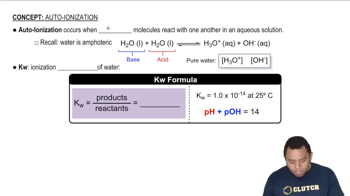
  • What does it mean that water is amphoteric?

    It means water can act as both an acid and a base.
  • What is autoionization in water?

    Autoionization is when water molecules react with each other, transferring an H+ ion from one molecule to another.
  • What ions are produced during the autoionization of water?

    Hydronium ions (H3O+) and hydroxide ions (OH-) are produced.
  • What is the ionization constant of water called?

    It is called Kw.
  • How is Kw expressed in terms of ion concentrations?

    Kw = [H3O+][OH-], the product of the concentrations of hydronium and hydroxide ions.
  • At what temperature is Kw equal to 1.0 × 10^-14?

    At 25°C.
  • What is the relationship between pH and pOH in water at 25°C?

    pH + pOH = 14.
  • Why are liquids and solids not included in the Kw expression?

    Because equilibrium constants only consider aqueous and gaseous species.
  • What happens to the concentration of OH- if the concentration of H3O+ increases?

    The concentration of OH- decreases, maintaining the balance in the solution.
  • What does it mean if [H3O+] equals [OH-] in a solution?

    The solution is neutral, as in pure water.
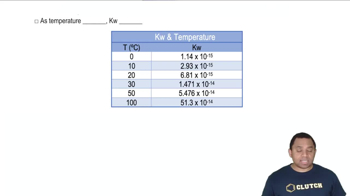
  • Is Kw temperature dependent?

    Yes, Kw changes with temperature.
  • What is the general trend of Kw as temperature increases?

    Kw generally increases as temperature increases.
  • If the temperature is not 25°C, will Kw still be 1.0 × 10^-14?

    No, Kw will have a different value at other temperatures.
  • Will you be given the value of Kw at temperatures other than 25°C?

    Yes, you will be provided with the new Kw value for calculations at other temperatures.
  • Why is remembering the value of Kw at 25°C important?

    Because it is a standard reference point in chemistry and is used in many calculations involving pH and pOH.