Balancing Chemical Equations quiz #1 Flashcards

Balancing Chemical Equations quiz #1
Control buttons has been changed to "navigation" mode.
1/40
  • Which symbol in a chemical equation separates the reactants from the products?
    The arrow (→) separates the reactants from the products in a chemical equation.
  • What is produced when calcium reacts with fluorine in a synthesis reaction? Ca + F2 → ________
    Calcium fluoride (CaF2) is produced: Ca + F2 → CaF2.
  • How many atoms of hydrogen are on the product side of the balanced equation: Fe + H2O → FeO + H2?
    There are 2 hydrogen atoms on the product side (in H2).
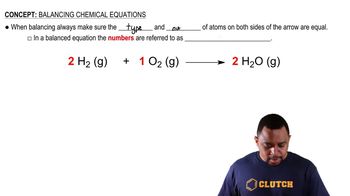
  • Which equation is correctly balanced for hydrogen and oxygen reacting to form water?
    2H2 + O2 → 2H2O is the correctly balanced equation.
  • Why is it important to include coefficients in chemical equations?
    Coefficients ensure the number of atoms of each element is equal on both sides, maintaining the law of conservation of mass.
  • What is the balanced equation for the combustion of magnesium?
    2Mg + O2 → 2MgO is the balanced equation for magnesium combustion.
  • Why do we adjust coefficients when balancing chemical equations and not subscripts?
    Adjusting coefficients changes the number of molecules, while changing subscripts alters the chemical identity of the compounds.
  • Why must chemical equations be balanced?
    Chemical equations must be balanced to obey the law of conservation of mass, ensuring equal numbers of atoms for each element on both sides.
  • Which of the following actions are permitted in balancing a chemical equation?
    You may change the coefficients, but not the subscripts, when balancing a chemical equation.
  • Which equation is balanced?
    An equation is balanced when the number of atoms of each element is the same on both sides of the arrow.
  • Which is the balanced equation for the fission of U-235?
    A balanced equation for U-235 fission is: U-235 + n → Ba-141 + Kr-92 + 3n.
  • Is the following chemical equation balanced? 2Na + 2H2O → 2NaOH + H2
    Yes, this equation is balanced.
  • Which of the following rules should you follow to balance chemical equations?
    Ensure the same number of each type of atom on both sides and only adjust coefficients, not subscripts.
  • Which of the following equations is balanced?
    An equation is balanced if the number of atoms of each element is equal on both sides.
  • Which of the following indicates that a chemical equation is balanced?
    The number and type of atoms for each element are equal on both sides of the equation.
  • 2HCl + Na2O → xNaCl + H2O. Which value of x will balance the equation?
    x = 2; the balanced equation is 2HCl + Na2O → 2NaCl + H2O.
  • What does a chemical equation describe?
    A chemical equation describes the reactants and products involved in a chemical reaction, showing their quantities.
  • What does the coefficient tell you?
    A coefficient indicates the number of molecules or moles of a substance in a chemical equation.
  • Where do coefficients belong in a chemical equation?
    Coefficients are placed in front of chemical formulas in a chemical equation.
  • Which statement is true for balanced chemical equations?
    Balanced chemical equations have equal numbers of each type of atom on both sides.
  • Which of the following statements about balancing reactions is false?
    It is false to say you can change subscripts to balance a chemical equation.
  • What are the numbers that you cannot change in a chemical equation?
    You cannot change the subscripts in chemical formulas when balancing equations.
  • Which equation is not balanced?
    An equation is not balanced if the number of atoms of any element differs between the reactants and products.
  • Which of the following chemical equations is balanced correctly?
    A correctly balanced equation has equal numbers of each atom on both sides.
  • Which balances the equation Mg + O2 → MgO?
    2Mg + O2 → 2MgO balances the equation.
  • What function does adding a coefficient in a chemical equation serve?
    Adding a coefficient changes the number of molecules, helping to balance the equation.
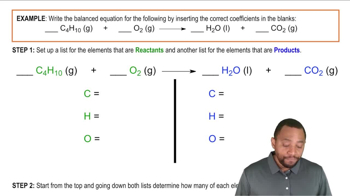
  • Which additional product balances this reaction? 2C2H2 (g) + 5O2 (g) → 4CO2 (g) + _______
    2H2O; the balanced equation is 2C2H2 + 5O2 → 4CO2 + 2H2O.
  • Which of the following chemical equations is correctly balanced?
    A correctly balanced equation has equal numbers of each atom on both sides.
  • What is (are) the starting material(s) in the reaction below?
    The starting materials are the reactants, which appear on the left side of the equation.
  • Which of the following is a balanced equation representing the decomposition of lead(IV) oxide?
    PbO2 → PbO + 1/2O2 or 2PbO2 → 2PbO + O2.
  • Which of the following chemical equations is balanced?
    A balanced equation has equal numbers of each atom on both sides.
  • Which of the following is true for balancing equations?
    Only coefficients should be changed, not subscripts, to balance equations.
  • Are the charges balanced?
    In a balanced chemical equation, both the atoms and charges must be balanced, especially in ionic reactions.
  • What law governs the balancing of chemical equations?
    The law of conservation of mass governs the balancing of chemical equations.
  • Which chemical equation is correctly balanced?
    A correctly balanced equation has equal numbers of each atom on both sides.
  • What is the coefficient of lithium fluoride in the balanced chemical reaction?
    The coefficient depends on the specific reaction, but in Li + F2 → 2LiF, the coefficient is 2.
  • What is a balanced chemical equation?
    A balanced chemical equation has equal numbers of each type of atom on both sides of the arrow.
  • What are the correct coefficients when this equation is balanced? Sb + O2 → Sb4O6
    4Sb + 3O2 → Sb4O6 are the correct coefficients.
  • If 4 atoms of hydrogen react with 2 atoms of oxygen, what is the balanced equation?
    2H2 + O2 → 2H2O is the balanced equation.
  • What is the total number of oxygen atoms on the left-hand side of this chemical equation?
    Count the oxygen atoms in all reactant compounds to find the total number.