Balancing Chemical Equations quiz #2 Flashcards

Balancing Chemical Equations quiz #2
Control buttons has been changed to "navigation" mode.
1/40
  • What information is not given by the coefficients in a balanced chemical equation?

    Coefficients do not provide information about the physical state or energy changes.
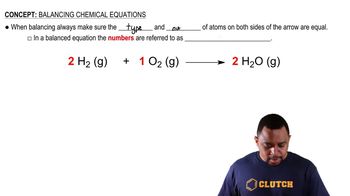
  • In the reaction 2H2 + O2 → 2H2O, how many molecules of water are produced?

    2 molecules of water are produced.
  • Why is it important to balance a chemical equation?

    Balancing ensures the law of conservation of mass is obeyed and allows for correct stoichiometric calculations.
  • Which of the following equations is balanced correctly?

    A balanced equation has equal numbers of each atom on both sides.
  • Why should you not change the subscripts in chemical formulas when balancing chemical equations?

    Changing subscripts alters the chemical identity of the compound.
  • How many different elements are in the chemical equation?

    Count the unique chemical symbols in the equation to determine the number of elements.
  • Which molecules in the following reaction are the reactants? NaOH + HCl → NaCl + H2O

    NaOH and HCl are the reactants.
  • Which chemical equation is unbalanced?

    An equation is unbalanced if the number of atoms of any element is not equal on both sides.
  • Which additional product balances the reaction H2SO4 + 2NaOH → Na2SO4 + ________?

    2H2O; the balanced equation is H2SO4 + 2NaOH → Na2SO4 + 2H2O.
  • Which condition must be met in order for an equation to be balanced?

    The number of atoms of each element must be equal on both sides.
  • Which statement best describes the formula equation Cl2(g) + 2KBr(aq) → 2KCl(aq) + Br2(l)?

    It is a balanced equation showing a double displacement reaction.
  • Which is the correctly balanced chemical equation for the reaction of KOH and H2SO4?

    2KOH + H2SO4 → K2SO4 + 2H2O is the balanced equation.
  • Which coefficient of O2 is needed to balance the equation C3H8 + O2 → 3CO2 + 4H2O?

    5; the balanced equation is C3H8 + 5O2 → 3CO2 + 4H2O.
  • Which additional product balances the reaction H2SO4 + 2NaOH → Na2SO4 + ________?

    2H2O; the balanced equation is H2SO4 + 2NaOH → Na2SO4 + 2H2O.
  • Which law represents a balanced chemical equation?

    The law of conservation of mass.
  • Which of the following best describes the reaction? 2H2S(g) + 3O2(g) → 2H2O(g) + 2SO2(g)

    It is a balanced chemical equation for the combustion of hydrogen sulfide.
  • What is the balanced reaction for the cell diagram below? Al(s) | Al3+(aq) || Cd2+(aq) | Cd(s)

    2Al(s) + 3Cd2+(aq) → 2Al3+(aq) + 3Cd(s)
  • Which sequence of coefficients should be placed in the blanks to balance this equation?

    The correct sequence is the set of numbers that makes the number of atoms equal on both sides.
  • Which statement best describes the equation CaCO3 + 2HCl → CaCl2 + CO2 + H2O?

    It is a balanced equation for the reaction of calcium carbonate with hydrochloric acid.
  • Consider the reaction 2Al(OH)3 + 3H2SO4 → x + 6y. What are x and y?

    x = Al2(SO4)3, y = H2O; the balanced equation is 2Al(OH)3 + 3H2SO4 → Al2(SO4)3 + 6H2O.
  • Balance the reaction V + O2 → VO when balanced.

    2V + O2 → 2VO is the balanced equation.
  • Consider the balanced equation below. What is the mole ratio of PCl3 to PCl5? 1:1 2:1 3:5 5:3

    The mole ratio depends on the equation, but for PCl3 + Cl2 → PCl5, it is 1:1.
  • Are these equations balanced or unbalanced? H2 + O2 → H2O; H2 + O2 → H2O2; K + O2 → K2O; Na + Cl → NaCl

    H2 + O2 → H2O is unbalanced; H2 + O2 → H2O2 is unbalanced; K + O2 → K2O is unbalanced; Na + Cl → NaCl is balanced.
  • 3NaBr + H3PO4 → Na3PO4 + 3HBr. Is this equation balanced?

    Yes, this equation is balanced.
  • What is the sum of the coefficients in the balanced equation for the reaction of Mn2+ with NaOH?

    The sum depends on the balanced equation; for Mn2+ + 2NaOH → Mn(OH)2 + 2Na+, the sum is 1 + 2 + 1 + 2 = 6.
  • What is the total number of oxygen atoms on the right-hand side of this chemical equation?

    Count the oxygen atoms in all product compounds to find the total number.
  • How many chlorine atoms are on the products side of the reaction 2Al + 6HCl → 2AlCl3 + 3H2?

    There are 6 chlorine atoms on the products side.
  • How many chlorine atoms are on the products side of the reaction 2Al + 6HCl → 2AlCl3 + 3H2?

    There are 6 chlorine atoms on the products side.
  • Which are the products in the equation CH3SH + 4O2 → CO2 + SO2 + 2H2O? Check all that apply.

    CO2, SO2, and H2O are the products.
  • Why does his teacher ask him to balance the equation by including the correct coefficients?

    To ensure the law of conservation of mass is obeyed and the equation accurately represents the reaction.
  • In the reaction 2Ca(s) + O2(g) → 2CaO(s), is the equation balanced?

    Yes, the equation is balanced.
  • NH3 + O2 → NO + H2O. Which of the following is the balanced form of the above unbalanced equation?

    4NH3 + 5O2 → 4NO + 6H2O is the balanced equation.
  • What are the coefficients for the reaction _Cl2O5 + _H2O → _HClO3 once it is balanced?

    1Cl2O5 + 1H2O → 2HClO3.
  • Which chemical symbols will complete the equation for this decomposition reaction?

    The chemical symbols are those of the products formed from the decomposition of the reactant.
  • Which is the balanced equation for S8 + O2 → SO2?

    S8 + 8O2 → 8SO2 is the balanced equation.
  • In the reaction 2H2O → 2H2 + O2, is the equation balanced?

    Yes, the equation is balanced.
  • What are the reactants in this equation? 3Mg(s) + 2FeCl3(aq) → 2Fe(s) + 3MgCl2(aq)

    3Mg and 2FeCl3 are the reactants.
  • What are the reactants in the following equation: HCl(aq) + NaHCO3(aq) → CO2(g) + H2O(l) + NaCl(aq)?

    HCl and NaHCO3 are the reactants.
  • Consider the balanced equation below. What is the mole ratio of Fe to another reactant?

    The mole ratio is determined by the coefficients in the balanced equation.
  • In a balanced chemical equation, the molar ratio of two reactants is determined from the

    Coefficients in the balanced chemical equation.