Back

Body Centered Cubic Unit Cell quiz

Control buttons has been changed to "navigation" mode.
1/15
  • How many atoms are present in a body centered cubic (BCC) unit cell?

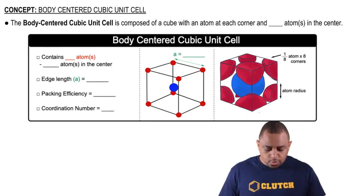
    There are 2 atoms in a BCC unit cell: 1 from the corners (shared) and 1 in the center.
  • Where is the unique atom located in a BCC unit cell?

    The unique atom is located at the center of the cube.
  • How much does each corner atom contribute to a single BCC unit cell?

    Each corner atom contributes 1/8 of an atom to the unit cell.
  • What is the formula for the edge length (a) of a BCC unit cell in terms of atomic radius (r)?

    The edge length a = 4r / √3, where r is the atomic radius.
  • Why is the edge length formula for BCC different from that of a simple cubic unit cell?

    In BCC, atoms do not touch along the edge, creating a small gap, so the formula changes.
  • What is the packing efficiency of a BCC unit cell?

    The packing efficiency of a BCC unit cell is 68%.
  • What does the packing efficiency of a unit cell represent?

    Packing efficiency represents the percentage of space occupied by atoms in the unit cell.
  • What is the coordination number of a BCC unit cell?

    The coordination number of a BCC unit cell is 8.
  • What does the coordination number indicate in a BCC structure?

    It indicates that each atom is surrounded by 8 nearest neighbors.
  • How many corner atoms are there in a BCC unit cell?

    There are 8 corner atoms in a BCC unit cell.
  • How many unit cells share a single corner atom in a BCC structure?

    A single corner atom is shared by 8 unit cells.
  • How does the complexity of a unit cell affect its packing efficiency?

    As the unit cell becomes more complex, its packing efficiency increases.
  • How does the complexity of a unit cell affect its coordination number?

    As the unit cell becomes more complex, its coordination number increases.
  • What is the main difference between a simple cubic and a BCC unit cell in terms of atom arrangement?

    A simple cubic has only corner atoms, while BCC has corner atoms plus one atom in the center.
  • Why is understanding the BCC structure important in materials science?

    It helps explain the properties of materials with a BCC lattice, such as their density and stability.