Bohr Model quiz #1 Flashcards

Bohr Model quiz #1
Control buttons has been changed to "navigation" mode.
1/38
  • How did Niels Bohr describe electrons in his atomic model?
    Bohr described electrons as traveling in defined circular orbits (shells) around the nucleus, each with a specific energy level.
  • Which is a feature of the Bohr model but not of the quantum mechanical model?
    Electrons move in fixed, circular orbits in the Bohr model, while the quantum mechanical model describes electrons in probabilistic clouds (orbitals).
  • What element does this Bohr model represent if it shows one electron orbiting the nucleus?
    The Bohr model with one electron orbiting the nucleus represents hydrogen.
  • According to the Bohr model of atomic quantization, how are electron energy levels defined?
    Electron energy levels are quantized and defined by the principal quantum number n; electrons can only occupy specific energy levels.
  • In the Bohr model of the atom, how do electrons move between energy levels?
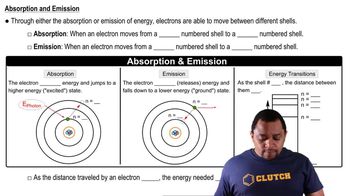
    Electrons move between energy levels by absorbing or emitting energy, transitioning to higher or lower shells.
  • What is an assumption Bohr made about the hydrogen atom?
    Bohr assumed that the electron in hydrogen moves in a fixed circular orbit with quantized energy levels.
  • Which element is represented by a Bohr model with six electrons orbiting the nucleus?
    A Bohr model with six electrons represents carbon.
  • What element is represented in a Bohr model with eight electrons?
    A Bohr model with eight electrons represents oxygen.
  • What element does the Bohr model represent if it has eleven electrons?
    A Bohr model with eleven electrons represents sodium.
  • In Bohr's model of the atom, what determines the energy of an electron?
    The energy of an electron is determined by its shell number (n) and the atomic number (Z), using the formula En = -R(Z^2/n^2).
  • Which statement best describes the Bohr model of the atom?
    Electrons orbit the nucleus in fixed shells with quantized energy levels.
  • Which particles did Bohr experiment with to develop his atomic model?
    Bohr's model was based on experiments with electrons in hydrogen atoms.
  • What does n designate in Bohr's atomic model?
    n designates the principal quantum number, representing the shell or energy level of an electron.
  • According to the Bohr model, how do electrons change energy levels?
    Electrons change energy levels by absorbing energy to move to a higher shell or emitting energy to move to a lower shell.
  • Which transition of an electron in the hydrogen atom will result in the absorption of light?
    An electron moving from a lower energy shell (e.g., n=1) to a higher energy shell (e.g., n=2 or n=3) absorbs light.
  • Which is the correct Bohr model for oxygen?
    The correct Bohr model for oxygen shows eight electrons: two in the first shell and six in the second shell.
  • Describe Bohr’s model of the atom. How does his model explain atomic spectra?
    Bohr’s model has electrons in quantized orbits; transitions between orbits explain the discrete lines in atomic spectra.
  • Which statement is part of Bohr's atomic model?
    Electrons occupy specific energy levels and can transition between them by absorbing or emitting energy.
  • Which element does this Bohr model represent if it has five electrons?
    A Bohr model with five electrons represents boron.
  • According to Bohr’s atomic model, what happens when an electron emits energy?
    When an electron emits energy, it moves from a higher energy shell to a lower energy shell.
  • What did the Bohr model of the atom predict?
    The Bohr model predicted the quantized energy levels of electrons and the spectral lines of hydrogen.
  • Which Bohr model represents boron?
    The Bohr model for boron has five electrons: two in the first shell and three in the second shell.
  • Which statement below does not follow the Bohr model?
    Electrons can exist anywhere around the nucleus without restriction to specific energy levels.
  • Which statement is true about the electrons in the Bohr model of an atom?
    Electrons occupy fixed orbits with specific energy levels and do not exist between these orbits.
  • What is the best description of the Bohr model of the atom?
    The Bohr model describes electrons in fixed, quantized orbits around the nucleus.
  • What does the arrow represent as an electron jumps from energy level 3 to level 1?
    The arrow represents the emission of energy as the electron moves to a lower energy shell.
  • According to Bohr's model of the atom, how is the energy of an electron determined?
    The energy is determined by the principal quantum number n and the atomic number Z, using En = -R(Z^2/n^2).
  • Why is the Bohr atom described as a planetary model?
    Because electrons orbit the nucleus in defined paths, similar to planets orbiting the sun.
  • Which statement about Niels Bohr’s atomic model is true?
    Bohr’s model introduced quantized energy levels for electrons in atoms.
  • What did Bohr’s model of the atom include that Rutherford’s model did not have?
    Bohr’s model included quantized electron energy levels, while Rutherford’s did not.
  • Why was Niels Bohr’s atomic model superior to all the earlier models?
    It explained atomic spectra and quantized electron energy levels, matching experimental observations.
  • Which are aspects covered by Bohr’s atomic model?
    Quantized electron energy levels, electron transitions, and explanation of atomic spectra.
  • Which statement is true comparing the research of Bohr to earlier atomic models?
    Bohr’s research explained the quantization of electron energy levels, unlike earlier models.
  • Bohr’s atomic model differed from Rutherford's because it explained that electrons...
    Electrons occupy specific energy levels and can transition between them by absorbing or emitting energy.
  • What is the Bohr model of magnesium?
    The Bohr model for magnesium has twelve electrons: two in the first shell, eight in the second, and two in the third shell.
  • What is the Bohr model for sodium?
    The Bohr model for sodium has eleven electrons: two in the first shell, eight in the second, and one in the third shell.
  • According to the Bohr model of atomic quantization, what energy do emitted photons have?
    Emitted photons have energy equal to the difference between the initial and final energy levels of the electron.
  • In Bohr's model of a hydrogen atom, electrons move in orbits labeled by the quantum number n. What does n represent?
    n represents the principal quantum number, indicating the shell or energy level of the electron.