Back

Bohr Model quiz

Control buttons has been changed to "navigation" mode.
1/15
  • In the Bohr model, what do electrons travel around the nucleus in?

    Electrons travel around the nucleus in circular orbits called shells.
  • What variable is used to represent the shell number in the Bohr model?

    The variable 'n' is used to represent the shell number.
  • What is the value of the Rydberg constant (R) in joules?

    The Rydberg constant is 2.178 x 10^-18 joules.
  • What particles are found in the nucleus of an atom?

    Protons and neutrons are found in the nucleus.
  • What is the charge of an electron?

    An electron has a negative charge.
  • How is the potential energy of an electron in a shell calculated in the Bohr model?

    It is calculated using the formula En = -R(Z^2/n^2), where R is the Rydberg constant, Z is the atomic number, and n is the shell number.
  • What does the atomic number (Z) represent in the energy formula?

    Z represents the atomic number of the element, which is the number of protons in the nucleus.
  • What happens during absorption in the Bohr model?

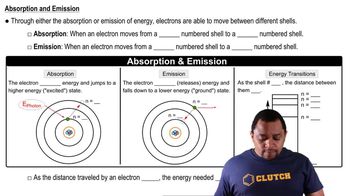
    During absorption, an electron moves from a lower numbered shell to a higher numbered shell by absorbing energy.
  • What is emission in the context of electron transitions?

    Emission is when an electron moves from a higher numbered shell to a lower numbered shell, releasing energy.
  • What is the ground state of an electron?

    The ground state is the lowest energy state of an electron, typically in the lowest shell.
  • What is the excited state of an electron?

    The excited state is when an electron is in a higher energy shell after absorbing energy.
  • How does the energy required for electron transitions change as shell number increases?

    As shell number increases, the distance between shells decreases, so less energy is required for transitions between higher shells.
  • Which transition requires more energy: from shell 1 to shell 2 or from shell 6 to shell 7?

    The transition from shell 1 to shell 2 requires more energy than from shell 6 to shell 7.
  • What is the relationship between the distance an electron travels between shells and the energy required?

    The greater the distance an electron travels between shells, the more energy is required for the transition.
  • Why is it easier for an electron to move from shell 6 to shell 7 than from shell 1 to shell 2?

    Because the distance (and thus the energy required) between higher shells is smaller than between lower shells.