Back

Bond Angles quiz

Control buttons has been changed to "navigation" mode.
1/15
  • What is a bond angle in a molecule?

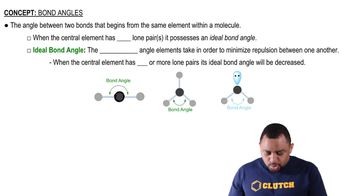
    A bond angle is the angle between two bonds that originate from the same central atom in a molecule.
  • How does the presence of lone pairs affect the ideal bond angle?

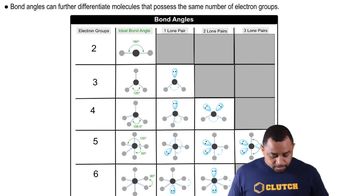
    Lone pairs decrease the ideal bond angle because they exert extra repulsion, pushing bonded atoms closer together.
  • What is the ideal bond angle for a linear molecule with two electron groups?

    The ideal bond angle for a linear molecule with two electron groups is 180 degrees.
  • What is the ideal bond angle for a trigonal planar molecule with three electron groups and no lone pairs?

    The ideal bond angle for a trigonal planar molecule with three electron groups and no lone pairs is 120 degrees.
  • How does adding a lone pair to a trigonal planar molecule affect its bond angle?

    Adding a lone pair to a trigonal planar molecule decreases the bond angle to less than 120 degrees.
  • What is the ideal bond angle for a tetrahedral molecule with four electron groups and no lone pairs?

    The ideal bond angle for a tetrahedral molecule with four electron groups and no lone pairs is 109.5 degrees.
  • How does the bond angle change when a tetrahedral molecule has one lone pair?

    The bond angle decreases to less than 109.5 degrees, typically around 107 degrees.
  • What happens to the bond angle when a tetrahedral molecule has two lone pairs?

    The bond angle decreases further, often to around 105 or 106 degrees.
  • How many different shapes can a molecule with five electron groups have?

    A molecule with five electron groups can have four different shapes.
  • What are the two types of bond angles in a five electron group molecule?

    The two types are 120 degrees (equatorial positions) and 90 degrees (between equatorial and axial positions).
  • How do lone pairs affect the bond angles in a five electron group molecule?

    Lone pairs decrease both the 120-degree and 90-degree bond angles.
  • What is the bond angle for a square planar molecule with six electron groups and no lone pairs?

    The bond angle for a square planar molecule with six electron groups and no lone pairs is 90 degrees.
  • How does the bond angle change in a six electron group molecule with one lone pair?

    The bond angle becomes less than 90 degrees for each gap.
  • What happens to the bond angle in a six electron group molecule with two lone pairs?

    The bond angle returns to being 90 degrees again.
  • Why is it unnecessary to memorize exact bond angles for molecules with lone pairs?

    Because many molecules fit these descriptions and the exact bond angle varies, it's more important to understand the trend that lone pairs decrease bond angles.