Back

Cell Notation quiz

Control buttons has been changed to "navigation" mode.
1/15
  • What is the purpose of cell notation in electrochemistry?

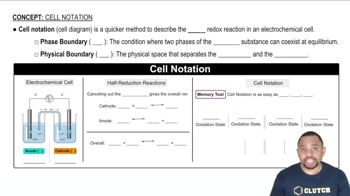
    Cell notation provides a quick and efficient way to describe the overall redox reaction in an electrochemical cell without drawing elaborate diagrams.
  • What does a single vertical line represent in cell notation?

    A single vertical line represents a phase boundary, indicating where two phases of the same substance coexist at equilibrium.
  • What does a double vertical line represent in cell notation?

    A double vertical line represents a physical boundary, separating the anode and cathode compartments of the electrochemical cell.
  • Where does oxidation occur in an electrochemical cell?

    Oxidation occurs at the anode, which is the site where electrons are lost.
  • Where does reduction occur in an electrochemical cell?

    Reduction occurs at the cathode, which is the site where electrons are gained.
  • In cell notation, which side is the anode written on?

    The anode is written on the left side of the cell notation.
  • In cell notation, which side is the cathode written on?

    The cathode is written on the right side of the cell notation.
  • What is the order of oxidation states in cell notation?

    Lower oxidation states are placed at the ends, and higher oxidation states are placed in the middle of the cell notation.
  • What is the cell notation for a cell with a chromium anode and copper cathode?

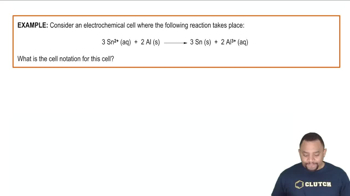
    The cell notation is Cr(s) | Cr²⁺(aq) || Cu²⁺(aq) | Cu(s).
  • What happens to electrons at the anode in a galvanic cell?

    Electrons are lost at the anode and move toward the cathode.
  • What happens to electrons at the cathode in a galvanic cell?

    Electrons are gained at the cathode during the reduction process.
  • What is the significance of the salt bridge in cell notation?

    The salt bridge is represented by the double vertical line and separates the anode and cathode compartments, but its ions are not explicitly shown in cell notation.
  • How are half-reactions combined in cell notation?

    Half-reactions are combined by canceling out intermediates, such as electrons, to yield the overall redox reaction.
  • What is the memory tool for cell notation described in the lesson?

    Cell notation is as easy as ABC: A for anode, B for the physical boundary, and C for cathode.
  • Why is cell notation preferred over drawing the entire cell diagram?

    Cell notation is preferred because it quickly communicates the essential details of the electrochemical cell without the need for a full diagram.