A chromatography column would be most efficient with which of the plate heights?
A chromatography column is most efficient with the smallest plate height, as smaller plate heights lead to better separation of components.
Which of these is a method used to separate different compounds in a mixture using a solvent?
Chromatography is a method used to separate different compounds in a mixture using a solvent.
Thin-layer chromatography separates components of a mixture based on which property?
Thin-layer chromatography separates components based on their affinity for the stationary phase (the plate) versus the mobile phase (the solvent).
What is the major underlying principle of chromatography?
The major principle of chromatography is the separation of mixture components due to differences in their molecular attractions to the stationary and mobile phases.
How could thin-layer chromatography be used to aid in the identification of a compound?
Thin-layer chromatography aids identification by measuring the distance a compound travels relative to the solvent (Rf value) and comparing it to known values.
What is the main purpose of the mobile phase in chromatography?
The main purpose of the mobile phase is to carry the mixture's components along the stationary phase, allowing separation based on their affinities.
What does it mean for a substance to be chromatophilic in the context of chromatography?
A chromatophilic substance has a high affinity for the mobile phase and moves further up the chromatography plate.
What happens when a sample is placed on a chromatography column?
When a sample is placed on a chromatography column, its components separate as they move at different rates depending on their affinities for the stationary and mobile phases.
How do you match pigments to bands on chromatography paper?
You match pigments to bands by calculating their Rf values and comparing them to known Rf values for specific pigments.
What is the role of capillary action in thin-layer chromatography?
Capillary action causes the solvent (mobile phase) to move up the silica plate, carrying the mixture's components with it. This movement enables the separation of compounds based on their affinities.
 Back
Back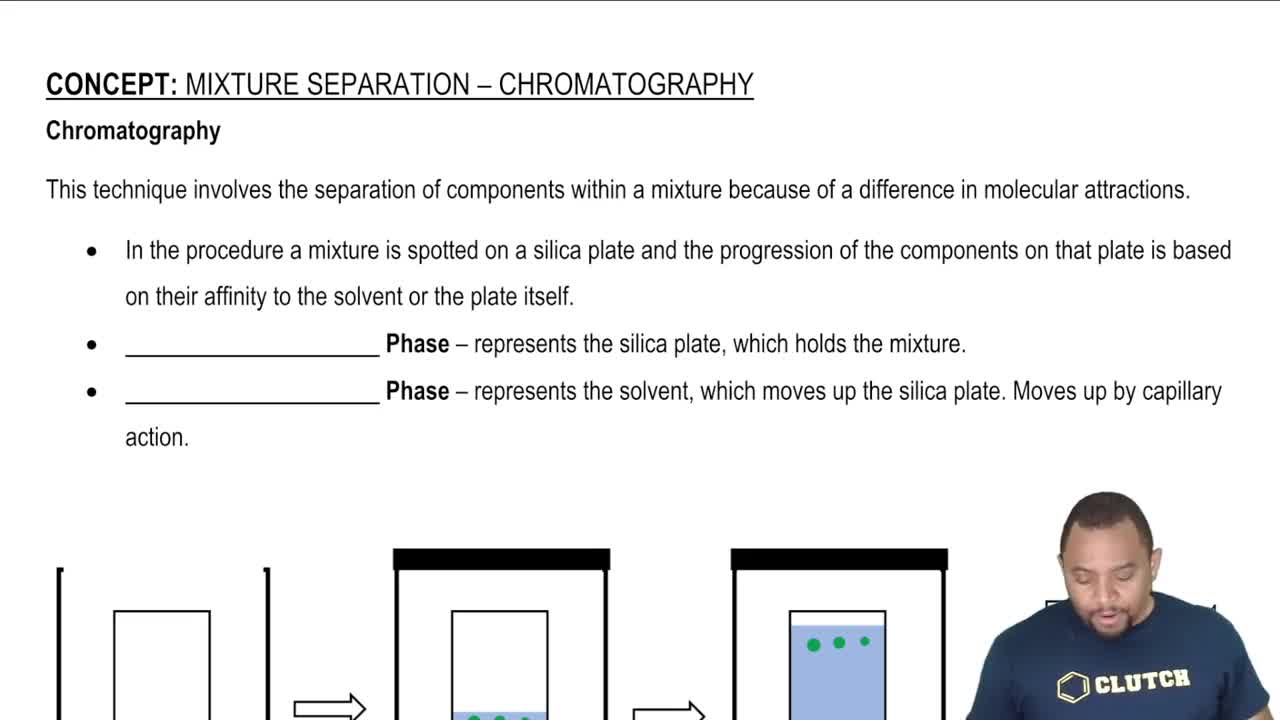
 04:50
04:50