Classification of Matter quiz #9 Flashcards

Classification of Matter quiz #9
Control buttons has been changed to "navigation" mode.
1/40
  • What are sugar and water in a homogeneous mixture of sugar and water?
    Sugar is the solute; water is the solvent.
  • Is water a compound?
    Yes, water is a compound.
  • How can you distinguish a substance from a mixture?
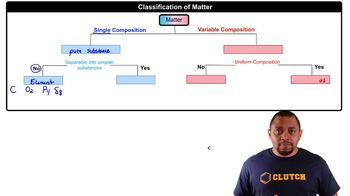
    A substance has a fixed composition; a mixture does not.
  • What type of mixture is dirt?
    Dirt is a heterogeneous mixture.
  • Calcium carbonate is considered a compound because it is made up of two or more of what?
    Different elements chemically bonded.
  • What is the difference between a meteor and a meteorite?
    A meteor is in the atmosphere; a meteorite has landed on Earth. (Chemistry context: Both are matter.)
  • What is a compound? Cite two examples.
    A compound is made of two or more elements chemically bonded. Examples: H2O, CO2.
  • What is the difference between a solute and solvent?
    The solute is dissolved; the solvent does the dissolving.
  • What is the tail of a comet made of?
    Dust and gases (matter).
  • What term describes anything that has weight and takes up space?
    Matter.
  • Which substance is an example of a colloid: milk, tomato juice, sand and water, sugar and water?
    Milk is a colloid.
  • Which is a pure substance: air, nitrogen, apple juice, tap water?
    Nitrogen is a pure substance.
  • How much of the air is made up of nitrogen?
    About 78%.
  • Which of the following observations would indicate that a material is a pure substance?
    It has a uniform and definite composition.
  • Which best describes what is made of matter?
    Anything that has mass and occupies space.
  • Which types of media contain at least one ingredient that is not chemically defined?
    Complex media (mixtures).
  • What is the hardest natural substance?
    Diamond.
  • Which of these is a compound?
    CO2 is a compound.
  • Which is a property of every mixture?
    Mixtures have variable composition.
  • Which is a positive effect of using chemistry?
    Chemistry helps develop useful materials and medicines.
  • What is the difference between elements and compounds?
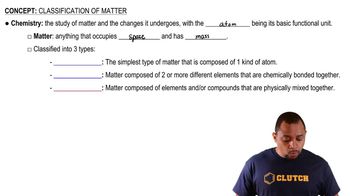
    Elements have one type of atom; compounds have two or more different elements.
  • Which of the following media can be described precisely as to its chemical content?
    Defined media (pure substances).
  • Using the Mohs hardness scale below
    Diamond is the hardest substance on the Mohs scale.
  • What is a mixture of elements that has metallic properties called?
    An alloy.
  • What type of compound is this?
    A compound is made of two or more elements chemically bonded.
  • The word evacuate contains the root vac. What does the root vac mean?
    Vac means empty (not directly chemistry, but relates to vacuum, which is absence of matter).
  • Which sample is a pure substance: zinc oxide, sugar dissolved in water, pond water, soil?
    Zinc oxide is a pure substance.
  • Which correctly lists three characteristics that are used to describe air?
    Air is a homogeneous mixture, has mass, and occupies space.
  • Which is an example of a nonaqueous solution: gasoline, fog, mayonnaise, fruit juice?
    Gasoline is a nonaqueous solution.
  • Which compound is inorganic: C6H12O6, KH2PO4, CH3COOH, C2H6, C2H5OH?
    KH2PO4 is inorganic.
  • Which substance is a mixture: table salt, gasoline, aluminum, carbon dioxide?
    Gasoline is a mixture.
  • Which will settle out if allowed to sit on a table: a suspension, a colloid, a solution, a compound?
    A suspension will settle out.
  • What is the correct classification of a mixture in which both a solid and a liquid are visible?
    A suspension.
  • Is air matter?
    Yes, air is matter.
  • Which correctly list the three gases that each make up less than 1 percent of earth's atmosphere?
    Argon, carbon dioxide, and neon.
  • Why is matter so diverse in its properties and characteristics?
    Because it is made of different elements and compounds in various combinations.
  • Which is a pure substance: soda, gasoline, salt water, carbon dioxide?
    Carbon dioxide is a pure substance.
  • How are the codes (chemical formulas) for pure substances different from those for mixtures?
    Pure substances have definite chemical formulas; mixtures do not.
  • Which of the following contains silica (SiO2)?
    Quartz contains silica.
  • Which of the following is true about mixtures and compounds?
    Mixtures can be separated physically; compounds can be separated chemically.