Back

Complete Ionic Equations quiz

Control buttons has been changed to "navigation" mode.
1/15
  • What does a complete ionic equation show?

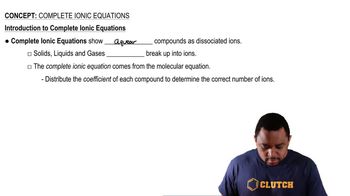
    A complete ionic equation shows aqueous compounds as their associated ions.
  • Which types of compounds are broken into ions in a complete ionic equation?

    Only aqueous compounds are broken into ions; solids, liquids, and gases are not.
  • What is the purpose of solubility rules in writing ionic equations?

    Solubility rules help determine which compounds are aqueous and can be broken into ions.
  • From which equation is the complete ionic equation derived?

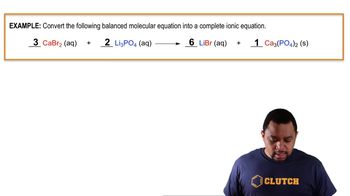
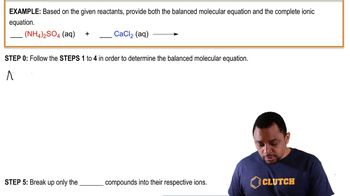
    The complete ionic equation is derived from the molecular equation.
  • How do you determine the correct number of ions in a complete ionic equation?

    You distribute the coefficient of each compound to the ions when writing the complete ionic equation.
  • What is a net ionic equation?

    A net ionic equation shows only the ions that participate in the chemical reaction, excluding spectator ions.
  • What are spectator ions?

    Spectator ions are ions that appear unchanged on both the reactant and product sides of the equation.
  • Are spectator ions included in the net ionic equation?

    No, spectator ions are removed from the net ionic equation.
  • What is the sequence of equations from start to finish when analyzing a reaction in solution?

    The sequence is molecular equation, then complete ionic equation, and finally net ionic equation.
  • Why do solids, liquids, and gases not break up into ions in ionic equations?

    They do not dissociate into ions in solution, so they remain as whole compounds in the equation.
  • What does the molecular equation list?

    The molecular equation lists all reactants and products, including aqueous compounds, solids, liquids, and gases.
  • Why is it important to identify aqueous compounds in a reaction?

    Because only aqueous compounds dissociate into ions and are shown as such in the complete ionic equation.
  • What does the net ionic equation reveal about a chemical reaction?

    It reveals the ions that are actively participating in the chemical transformation.
  • How are coefficients used in writing complete ionic equations?

    Coefficients are applied to each ion to reflect the correct number present in the reaction.
  • What is the main difference between a complete ionic equation and a net ionic equation?

    A complete ionic equation shows all ions present, while a net ionic equation shows only those involved in the reaction.