Coulomb's Law quiz #1 Flashcards

Coulomb's Law quiz #1
Control buttons has been changed to "navigation" mode.
1/10
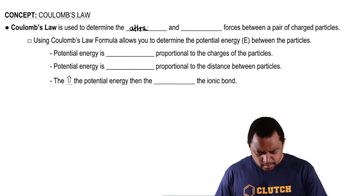
  • Why are protons and electrons attracted to each other according to Coulomb's Law?
    Protons and electrons are attracted to each other because they have opposite electric charges, and Coulomb's Law states that opposite charges experience an attractive force proportional to the magnitude of their charges and inversely proportional to the square of the distance between them.
  • What type of attraction pulls electrons close to the atomic nucleus according to Coulomb's Law?
    The electrostatic (Coulombic) attraction between the negatively charged electrons and the positively charged protons in the nucleus pulls electrons close to the atomic nucleus.
  • What happens to the potential energy between two charged particles as the distance between them increases?
    As the distance between two charged particles increases, their potential energy decreases according to Coulomb's Law.
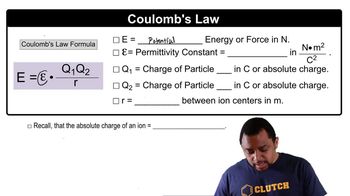
  • What does the variable 'k' represent in the Coulomb's Law formula?
    The variable 'k' represents the permittivity constant, which is 9.0 × 10^9 N·m^2/C^2.
  • How do you convert an ion's charge from its absolute value to coulombs?
    You multiply the ion's absolute charge by 1.602 × 10^-19 to convert it to coulombs.
  • If an ion has a charge of +2, what is its charge in coulombs?
    Its charge in coulombs is 3.204 × 10^-19 C.
  • What does the variable 'r' represent in the Coulomb's Law equation?
    The variable 'r' represents the distance between the centers of the ions, measured in meters.
  • How does the magnitude of the charges affect the potential energy between two particles?
    The potential energy increases as the magnitude of the charges increases.
  • Why is understanding Coulomb's Law important for predicting ionic bond strength?
    Coulomb's Law helps predict ionic bond strength because greater potential energy means a stronger ionic bond.
  • In the context of Coulomb's Law, what units are used for potential energy or force?
    Potential energy or force is measured in newtons (N) according to the formula.