Density quiz #3 Flashcards

Density quiz #3
Control buttons has been changed to "navigation" mode.
1/40
  • Which property determines whether one substance will sink or float in another substance?
    Density determines whether a substance will sink or float.
  • Which of the following represents the best definition for density?
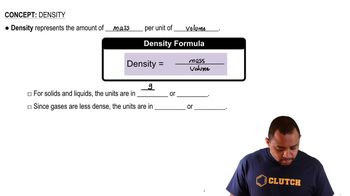
    Density is the mass of a substance per unit volume.
  • How does the density of a liquid compare to the density of the same substance as a solid?
    Solids are usually more dense than liquids, except for water.
  • Why does oil float in water?
    Oil floats because its density is less than water's density.
  • What are volume and density? How do they relate to each other?
    Volume is the space an object occupies; density is mass per unit volume.
  • What is the density of glycerol in g/cm³?
    Glycerol has a density of about 1.26 g/cm³.
  • What is the density of fluorine gas at STP?
    Fluorine gas has a density of about 1.7 g/L at STP.
  • What determines the density of a substance?
    Density is determined by the substance's mass and volume.
  • What is the amount of matter in an object?
    The amount of matter in an object is its mass.
  • What is the density of a block with a mass of 36 g and a volume of 9 cm³?
    Density = 36 g / 9 cm³ = 4 g/cm³.
  • What is the formula for calculating the density of an object?
    Density = mass / volume.
  • An object with which of the following densities will float on water?
    An object with a density less than 1 g/cm³ will float on water.
  • What is the volume of 45.6 g of silver if the density of silver is 10.5 g/mL?
    Volume = 45.6 g / 10.5 g/mL ≈ 4.34 mL.
  • A sphere with a mass of 12 g has a radius measuring 2 cm. What is its density?
    Calculate volume (V = 4/3πr³), then density = mass/volume.
  • What element has the lowest density of all of the elements?
    Hydrogen has the lowest density of all elements.
  • Volume is the product of which of the following?
    Volume is the product of length × width × height for regular solids.
  • Which of these substances will float in water?
    Substances with density less than 1 g/cm³ will float in water.
  • What is the difference between volume and mass?
    Volume is the space occupied; mass is the amount of matter.
  • Which of the following materials is the most dense?
    The material with the highest mass per unit volume is most dense.
  • Water is most dense at what temperature?
    Water is most dense at about 4°C.
  • What is the density of nitrogen gas at STP?
    Nitrogen gas has a density of about 1.25 g/L at STP.
  • Which form of iron has a higher density?
    Solid iron has a higher density than liquid iron.
  • A certain material has a density of 19.3 g/mL. What is the material?
    Gold has a density of 19.3 g/cm³ (or g/mL).
  • If a sample has a volume of 2 mL and a mass of 10 grams, what is its density?
    Density = 10 g / 2 mL = 5 g/mL.
  • How can you use density to tell if tea is sweetened?
    Sweetened tea has higher density than unsweetened tea.
  • Why is density referred to as a characteristic property of matter?
    Density is unique to each substance and does not change with sample size.
  • How can you determine that a coin is not pure silver if you know the mass and volume of the coin?
    Calculate its density and compare to pure silver's density.
  • A piece of metal has a mass of 60 g and a volume of 3 cm³. What is its density?
    Density = 60 g / 3 cm³ = 20 g/cm³.
  • Which of these has the lowest density?
    Gases generally have the lowest density.
  • What is the density of a liquid that has a volume of 20 mL and a mass of 3 g?
    Density = 3 g / 20 mL = 0.15 g/mL.
  • Which of the following has the lowest density?
    The substance with the smallest mass per unit volume has the lowest density.
  • What is the density of oxygen gas at STP?
    Oxygen gas has a density of about 1.43 g/L at STP.
  • What is the measurement of the amount of matter in an object?
    Mass measures the amount of matter in an object.
  • What operation would you use to find the mass of an object given its density and volume?
    Multiply density by volume to find mass.
  • Why does ice float after it crystallizes?
    Ice floats because its density is less than liquid water.
  • What is the density of water?
    The density of water is 1.0 g/cm³ or 1.0 g/mL.
  • What is the density of an object?
    Density is the object's mass divided by its volume.
  • What do you notice about the density of the sinking objects?
    Sinking objects have a density greater than the fluid they are in.
  • Does ice float or sink?
    Ice floats in water.
  • What is the difference between mass and density?
    Mass is the amount of matter; density is mass per unit volume.