Density quiz #5 Flashcards

Density quiz #5
Control buttons has been changed to "navigation" mode.
1/40
  • What has to be true about mass if a small object (like a metal ball) has a high density?
    It must have a large mass relative to its volume.
  • What is the mass density of water? What is water's normal weight density?
    Mass density: 1.0 g/cm³; weight density: 9.8 kN/m³.
  • Which of the following can cause an increase in the density of ocean water?
    Increasing salinity or decreasing temperature.
  • What happens to the density of water as its salinity increases?
    Density increases.
  • Which liquid has the highest density?
    Mercury has the highest density among common liquids.
  • The density of water is 1 g/cm³. What is that in kg/m³?
    1 g/cm³ = 1000 kg/m³.
  • How do you calculate the density of air?
    Divide the mass of air by its volume.
  • What is the mass density of water? What is the weight density of water?
    Mass density: 1.0 g/cm³; weight density: 9.8 kN/m³.
  • The density of solid Cu is 8.96 g/cm³. How many atoms are present per cubic centimeter (cm³) of Cu?
    Use density and molar mass to calculate atoms per cm³.
  • What is the density of a rock with a mass of 20 grams and a volume of 10 mL?
    Density = 20 g / 10 mL = 2 g/mL.
  • How much does a gallon of water weigh?
    A gallon of water weighs about 8.34 pounds (3.78 kg).
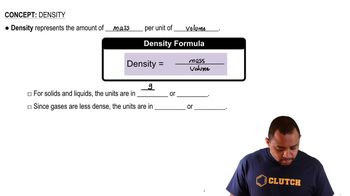
  • What is the formula for calculating density?
    Density = mass / volume.
  • Density is divided into which of the two factors?
    Density is mass divided by volume.
  • Which object will sink in freshwater?
    Objects with density greater than 1 g/cm³ will sink in freshwater.
  • Which describes density?
    Density is mass per unit volume.
  • Which describes how to calculate density?
    Divide mass by volume.
  • Which describes a value for density?
    Density is expressed in units like g/cm³ or g/mL.
  • Which phrase describes density?
    Density is the amount of mass in a given volume.
  • If the volume of an object is 5 cm³ and its mass is 55 g, what is its density?
    Density = 55 g / 5 cm³ = 11 g/cm³.
  • How can the density of an object be determined?
    Measure mass and volume, then divide mass by volume.
  • If the density and volume of an object is known, how do you find its mass?
    Multiply density by volume to find mass.
  • How are mass and volume alike?
    Both are physical properties; together they determine density.
  • How does the density change from warm water to cold water?
    Cold water is denser than warm water.
  • A ball has a mass of 33.6 grams and a volume of 14.0 cubic centimeters (cc). What is its density?
    Density = 33.6 g / 14.0 cm³ = 2.4 g/cm³.
  • What is the density of the unknown liquid?
    Density = mass / volume (values needed for calculation).
  • Aluminum has a density of 2.7 g/cm³. What quantity is in a block of the metal substance?
    Each cm³ of aluminum has a mass of 2.7 grams.
  • What is the mass of 2.00 L of an intravenous glucose solution with a density of 1.15 g/mL?
    Mass = 1.15 g/mL × 2000 mL = 2300 g.
  • A box of ice cream has a volume of 1.75 quarts. What is the volume in units of cubic inches?
    1 quart = 57.75 in³; 1.75 quarts = 101.06 in³.
  • The density of a sample of gas is 1.0 g/L. What is the density in units of mg/mL?
    1.0 g/L = 1 mg/mL.
  • If an object has a density of 8.65 g/cm³, what is its density in units of kg/m³?
    8.65 g/cm³ = 8650 kg/m³.
  • A lead ball has a mass of 55.0 grams and a density of 11.4 g/cm³. What is the volume of the ball?
    Volume = 55.0 g / 11.4 g/cm³ ≈ 4.82 cm³.
  • The density of solid Ni is 8.90 g/cm³. How many atoms are present per cubic centimeter (cm³) of Ni?
    Use density and molar mass to calculate atoms per cm³.
  • You have 2.7 kg of a sample in your lab that occupies 0.001 m³ of volume. What substance is it?
    Density = 2.7 kg / 0.001 m³ = 2700 kg/m³, which matches aluminum.
  • The density of solid Cr is 7.15 g/cm³. How many atoms are present per cubic centimeter (cm³) of Cr?
    Use density and molar mass to calculate atoms per cm³.
  • Which is more concentrated in iodine: beaker or tube?
    The one with higher density of iodine is more concentrated.
  • What is the density of a wooden cube that has a mass of 59.3g and an edge length of 4.30cm?
    Volume = 4.30³ cm³ = 79.5 cm³; Density = 59.3 g / 79.5 cm³ ≈ 0.75 g/cm³.
  • What is the density of Xe gas at a pressure of 788 mmHg?
    Use ideal gas law and molar mass to calculate density.
  • A gas with a molar mass of 26.54 g/mol is at a pressure of 172 torr and 27°C. What is its density?
    Use ideal gas law to calculate density.
  • What is the density of CO₂ gas at STP conditions if 2.50 g occupies 5.60 L at 789 torr?
    Density = 2.50 g / 5.60 L ≈ 0.446 g/L.
  • How many grams of water are contained in a 0.127 L sample at 20°C?
    Mass = 0.127 L × 1000 g/L = 127 g.