Density quiz #6 Flashcards

Density quiz #6
Control buttons has been changed to "navigation" mode.
1/40
  • What would be the density (in g/L) of a sample of N₂ gas at 70.0°C and 2.50 atm of pressure?
    Use ideal gas law to calculate density.
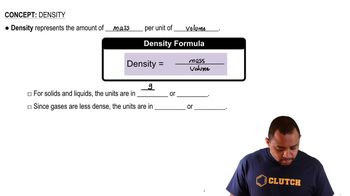
  • What is the formula for density?
    Density = mass / volume.
  • Which expression represents the volume?
    Volume = mass / density.
  • What does the word hydrometer mean?
    A hydrometer is a device used to measure the density or specific gravity of liquids.
  • What happens when an object has a density greater than that of the surrounding liquid?
    It sinks.
  • How do you calculate density?
    Divide mass by volume.
  • Which statement describes the density of the inner planets?
    Inner planets are denser than outer planets.
  • How is density calculated?
    Density is calculated by dividing mass by volume.
  • What is the definition of density?
    Density is the mass of a substance per unit volume.
  • What is the thermocline?
    The thermocline is a layer in water where temperature changes rapidly with depth, affecting density.
  • Which statements describe density? Check all that apply.
    Density is mass per unit volume; it is a physical property; it helps determine if objects sink or float.
  • What is the density of a 700 kg object with a volume of 649 m³?
    Density = 700 kg / 649 m³ ≈ 1.08 kg/m³.
  • Which would be the best tools to measure the density of a small piece of silver ore?
    A balance for mass and a graduated cylinder for volume.
  • Which medium (1 or 2) is more dense?
    The medium with higher mass per unit volume is more dense.
  • Which of the following statements explains why the ice floats on the surface of the pond?
    Ice floats because its density is less than that of liquid water.
  • Vegetable oil has a density of 0.92 g/cm³. Which of these substances would float on vegetable oil?
    Substances with density less than 0.92 g/cm³ will float on vegetable oil.
  • If a rock sample has a mass of 11.2 g and a volume of 1.9 cm³, what is its density?
    Density = 11.2 g / 1.9 cm³ ≈ 5.89 g/cm³.
  • Which is the best estimate for the volume of a shampoo bottle?
    About 250 mL.
  • Which state of matter typically has the highest density? (Water is a weird exception to this.)
    Solids typically have the highest density.
  • Which is not a type of density?
    Color density is not a type of density.
  • If a wooden ball has a mass of 2.4g and a volume of 6cm³, what is its density?
    Density = 2.4 g / 6 cm³ = 0.4 g/cm³.
  • If the density of an unknown gas Z is 4.50 g/L at STP, what does this mean?
    Each liter of gas Z has a mass of 4.50 grams at STP.
  • Which medium (1 or 2) is more dense?
    The medium with higher mass per unit volume is more dense.
  • A piece of wood measures 4 in x 6 in x 3 in and has a mass of 80 grams. What is its density?
    Volume = 4 × 6 × 3 = 72 in³; convert to cm³, then density = mass/volume.
  • What does density measure?
    Density measures mass per unit volume.
  • How could you demonstrate to a child that solid water is less dense than liquid water?
    Show that ice floats in water.
  • What is the relationship between sparging in the lauter tun and specific gravity?
    Sparging affects the specific gravity (density) of the liquid extracted.
  • Which of the following water types would be the densest?
    Cold, salty water.
  • What happens to the density of a material if you have a larger piece of it?
    Density remains the same; it is independent of sample size.
  • Which element has the lowest density at 298 K and 101.3 kPa?
    Hydrogen.
  • What is the density (g/mL) of a sample of mineral oil if 250 mL has a mass of 0.23 kg?
    Density = 230 g / 250 mL = 0.92 g/mL.
  • What is the density of 2.5 g of gaseous sulfur held at 130 kPa and 10.0°C?
    Use ideal gas law to calculate density.
  • What is the density of the block if it has a mass of 45.5 grams and a volume of 2.4 cm³?
    Density = 45.5 g / 2.4 cm³ ≈ 18.96 g/cm³.
  • A 30 kg sample of an unknown material has a volume of 15 m³. What is its density in kg/m³?
    Density = 30 kg / 15 m³ = 2 kg/m³.
  • How does the density of a substance change if you were to double its size?
    Density does not change; it is independent of size.
  • Which object would sink in honey, which has a density of 1.4 g/cm³?
    Objects with density greater than 1.4 g/cm³ will sink in honey.
  • The density of NO₂ in a 4.50 L tank at 760.0 torr and 25.0°C is ________ g/L.
    Use ideal gas law to calculate density.
  • 20 mL of pure water weighs how much?
    20 mL × 1 g/mL = 20 g.
  • An increase in seawater density can be caused by ________.
    Increasing salinity or decreasing temperature.
  • The length of the side of a cube having a density of 12.6 g/mL and a mass of 7.65 g is ________ cm.
    Volume = mass/density; side = cube root of volume.