Density quiz #7 Flashcards

Density quiz #7
Control buttons has been changed to "navigation" mode.
1/26
  • A liquid in the lab has a density of 1.17 g/cm³. What does this mean?
    Each cm³ of the liquid has a mass of 1.17 grams.
  • The density of pure silver is 10.5 g/cm³ at 20°C. What does this mean?
    Each cm³ of silver has a mass of 10.5 grams at 20°C.
  • Density is correctly described as a ______.
    Physical property.
  • Which value would most likely represent the density of the object: –1 g/cm³, 4 m/s, –3 m/s, 6 g/cm³?
    6 g/cm³ is a valid density value.
  • To determine a planet's average density, we can use what formula?
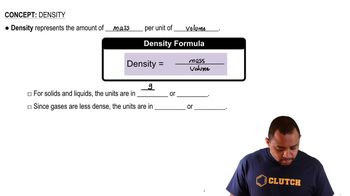
    Average density = mass / volume.
  • In your own words, explain what the concept of density means—without using the formula.
    Density describes how much matter is packed into a certain amount of space.
  • How much space an object takes up is called what?
    Volume.
  • The density of ice is the same as that of liquid water at the same temperature. True or false?
    False.
  • 30 gallons of water weigh how much?
    30 gallons × 8.34 lbs/gallon ≈ 250 lbs.
  • A sample of brass weighing 1.203 grams has what density?
    Density = mass / volume (volume needed for calculation).
  • Mass, volume and density are all properties of what?
    Matter.
  • If two items are equal in size, the denser one will do what?
    It will sink in a fluid of lower density.
  • 4 gallons of water weigh how much?
    4 gallons × 8.34 lbs/gallon ≈ 33.4 lbs.
  • When water is heated what happens to its density?
    Its density decreases.
  • 1 kg helium with a volume of 5.587 m³ has what density?
    Density = 1 kg / 5.587 m³ ≈ 0.179 kg/m³.
  • What's the relationship between the temperature and the density of a substance?
    As temperature increases, density decreases.
  • How is density related to the layers of the earth?
    Earth's layers are arranged by density, with denser materials deeper.
  • Density is the amount of mass in a certain what?
    Volume.
  • Water has a density of ~1 g/cm³ ~1000 kg/m³. Estimate the mass of Earth's oceans (in kg).
    Multiply ocean volume by 1000 kg/m³ for mass estimate.
  • How much does 100 gallons of water weigh?
    100 gallons × 8.34 lbs/gallon = 834 lbs.
  • Consider the given graph of an object's mass and volume. What is the density of the object, in g/mL?
    Density = mass / volume (values needed for calculation).
  • What is the relationship between mass, volume, and density?
    Density is mass divided by volume.
  • A liquid in the lab has a density of 1.24 g/cm³. What does this mean?
    Each cm³ of the liquid has a mass of 1.24 grams.
  • Calculate the density of FeO, given that it has the rock salt crystal structure.
    Use mass and volume of FeO unit cell to calculate density.
  • Density of porcelain is approximately what?
    Porcelain has a density of about 2.3–2.5 g/cm³.
  • What is the density of honey in g/mL?
    Honey has a density of about 1.4 g/mL.