Back

Density quiz

Control buttons has been changed to "navigation" mode.
1/15
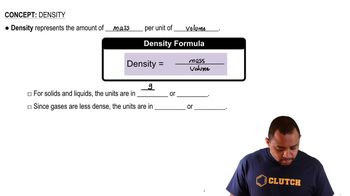
  • What is the formula for density?

    Density is calculated as mass divided by volume (d = m/V).
  • What does density represent in chemistry?

    Density represents the amount of mass per unit of volume.
  • What are the typical units for density of solids and liquids?

    Density for solids and liquids is usually measured in grams per milliliter (g/mL) or grams per cubic centimeter (g/cm³).
  • What is the relationship between milliliters and cubic centimeters?

    1 milliliter is equal to 1 cubic centimeter (1 mL = 1 cm³).
  • Why can we use milliliters and cubic centimeters interchangeably for density calculations?

    Because 1 mL is equivalent to 1 cm³, so they represent the same volume.
  • How does the density of gases compare to solids and liquids?

    Gases are much less dense than solids and liquids.
  • What units are commonly used for the density of gases?

    Density of gases is often measured in grams per liter (g/L) or grams per decimeter cubed (g/dm³).
  • What is the relationship between liters and decimeters cubed?

    1 liter is equal to 1 decimeter cubed (1 L = 1 dm³).
  • What is the unit for mass in density calculations for all phases of matter?

    The unit for mass is grams (g) for solids, liquids, and gases.
  • Why are different units used for density depending on the phase of matter?

    Different units are used because solids and liquids are more dense, requiring smaller volume units, while gases are less dense and use larger volume units.
  • What is the significance of the purple box in the lesson?

    The purple box indicates a formula or concept that should be memorized.
  • How do you convert between g/mL and g/cm³ for density?

    You can use them interchangeably because 1 mL equals 1 cm³.
  • What is the formula for density if you know mass and volume?

    Density equals mass divided by volume (d = m/V).
  • Why is understanding unit conversion important in density calculations?

    It ensures accurate measurement and comparison of densities across different states of matter.
  • What is the main concept to remember about density from this lesson?

    Density is mass over volume, and the units depend on whether the substance is a solid, liquid, or gas.