Back

Electroplating quiz

Control buttons has been changed to "navigation" mode.
1/15
  • What is electroplating?

    Electroplating is the use of electrical current to deposit metal cations onto a metal electrode.
  • What is the SI unit for electrical current?

    The SI unit for electrical current is the ampere (A).
  • How is 1 ampere defined in terms of coulombs and seconds?

    1 ampere is equal to 1 coulomb per second.
  • What direction do electrons travel in an electroplating circuit?

    Electrons travel from the anode to the cathode in a closed circuit.
  • What is the first step when given time in an electroplating calculation?

    Convert the given time to seconds.
  • How do you calculate charge from current and time?

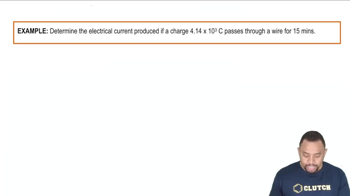
    Multiply the current (in amperes) by the time (in seconds) to get charge in coulombs.
  • What is Faraday's constant and its value?

    Faraday's constant is 96,485 coulombs per mole of electrons.
  • How do you convert charge to moles of electrons?

    Divide the charge (in coulombs) by Faraday's constant to get moles of electrons.
  • What is the purpose of the mole-to-electron comparison in electroplating calculations?

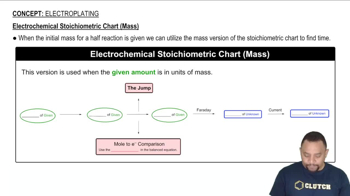
    It allows conversion from moles of electrons to moles of the plated element using balanced equation coefficients.
  • How do you convert moles of a substance to grams?

    Multiply the moles by the atomic mass of the element.
  • What is the process when starting with mass in electroplating calculations?

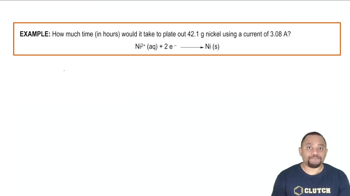
    Convert grams to moles, then to moles of electrons, then to charge, and finally use current to find time.
  • What is the role of the balanced chemical equation in electroplating stoichiometry?

    It provides the coefficients needed for the mole-to-electron comparison.
  • What units can moles of a plated element be converted into?

    Moles can be converted into grams, molecules, ions, or kilograms.
  • How do you find the time required for electroplating when starting with mass?

    Convert mass to moles, then to moles of electrons, then to charge, and use current to calculate time in seconds.
  • What is the relationship between current, charge, and time in electroplating?

    Current is the rate of charge flow, so charge equals current times time.