Back

Emission Spectrum quiz

Control buttons has been changed to "navigation" mode.
1/15
  • What is an emission spectrum?

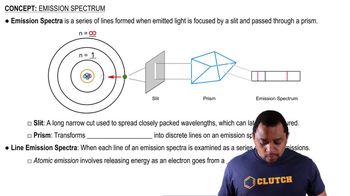
    An emission spectrum is a pattern of colored lines produced when electrons in an atom drop from higher to lower energy levels, releasing energy as light.
  • How is an emission spectrum produced in the laboratory?

    It is produced by focusing emitted light through a slit and passing it through a prism, which separates the light into distinct colored lines.
  • What does each line in an emission spectrum represent?

    Each line corresponds to a specific energy change as an electron moves between two energy shells in an atom.
  • What is the role of the slit in observing emission spectra?

    The slit focuses the emitted light and helps spread closely packed wavelengths for better separation.
  • What does the prism do in the context of emission spectra?

    The prism separates the focused light into discrete colored lines, making the emission spectrum visible.
  • What happens to an electron during emission?

    During emission, an electron transitions from a higher energy shell to a lower one, releasing energy as light.
  • What type of electromagnetic radiation is emitted when electrons fall to the first shell?

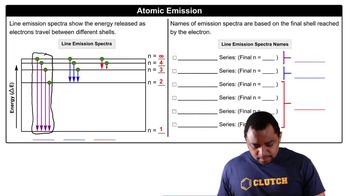
    When electrons fall to the first shell, ultraviolet (UV) light is emitted, known as the Lyman series.
  • Which series corresponds to electrons falling to the second shell?

    Electrons falling to the second shell emit visible light, which is called the Balmer series.
  • What type of light is emitted when electrons fall to the third or higher shells?

    Electrons falling to the third or higher shells emit infrared light, corresponding to the Paschen, Brackett, Pfund, and Humphrey series.
  • How are the names of emission series determined?

    The names of emission series are based on the final shell reached by the electron and are named after the scientists who discovered them.
  • What is the Lyman series?

    The Lyman series consists of UV light emissions from electrons dropping to the first shell.
  • What is the Balmer series?

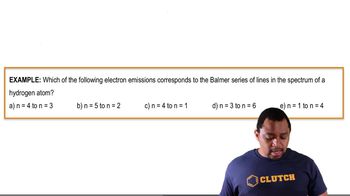
    The Balmer series consists of visible light emissions from electrons dropping to the second shell.
  • What are the Paschen, Brackett, Pfund, and Humphrey series?

    These series represent infrared emissions from electrons dropping to the third, fourth, fifth, and sixth shells, respectively.
  • Why are emission spectra important in chemistry?

    Emission spectra are crucial for identifying atomic composition and understanding electron transitions within atoms.
  • What determines the type of electromagnetic radiation emitted in an electron transition?

    The final shell the electron lands on determines whether the emitted radiation is UV, visible, or infrared.