Empirical Formula quiz #3 Flashcards

Empirical Formula quiz #3
Control buttons has been changed to "navigation" mode.
1/10
  • What is the empirical formula of acetic acid, HC2H3O2?

    The empirical formula is CH2O.
  • Write the empirical formula of copper chloride based on the experimental data.

    The empirical formula is CuCl2.
  • How is the empirical formula determined from the molecular formula?

    The empirical formula is found by dividing the subscripts in the molecular formula by their greatest common factor to get the simplest whole number ratio.
  • What does the empirical formula represent in a compound?

    It represents the simplest whole number ratio of the elements present in the compound.
  • When are the empirical and molecular formulas of a compound identical?

    They are identical when the subscripts in the molecular formula cannot be reduced by any common factor.
  • What is the role of mass percentage in determining the empirical formula?

    Mass percentage helps calculate the relative number of moles of each element, which is then used to find the simplest ratio for the empirical formula.
  • Why must the empirical formula contain whole numbers for each atom?

    Because chemical formulas represent actual atoms, and atoms cannot be split into fractions in a formula.
  • What is the relationship between the mole concept and empirical formulas?

    The mole concept allows conversion between mass and moles, which is necessary to determine the simplest ratio of atoms for the empirical formula.
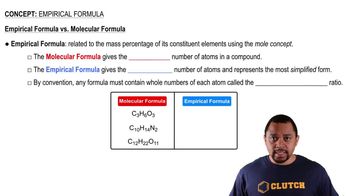
  • If a compound has a molecular formula of C10H14N2, what is its empirical formula?

    Its empirical formula is C5H7N, obtained by dividing each subscript by 2.
  • What does the molecular formula tell you that the empirical formula does not?

    The molecular formula gives the exact number of each type of atom in a molecule, while the empirical formula only shows the simplest ratio.