Back

Formation Equations quiz

Control buttons has been changed to "navigation" mode.
1/15
  • What are the three standard states in which elements exist at room temperature and standard pressure?

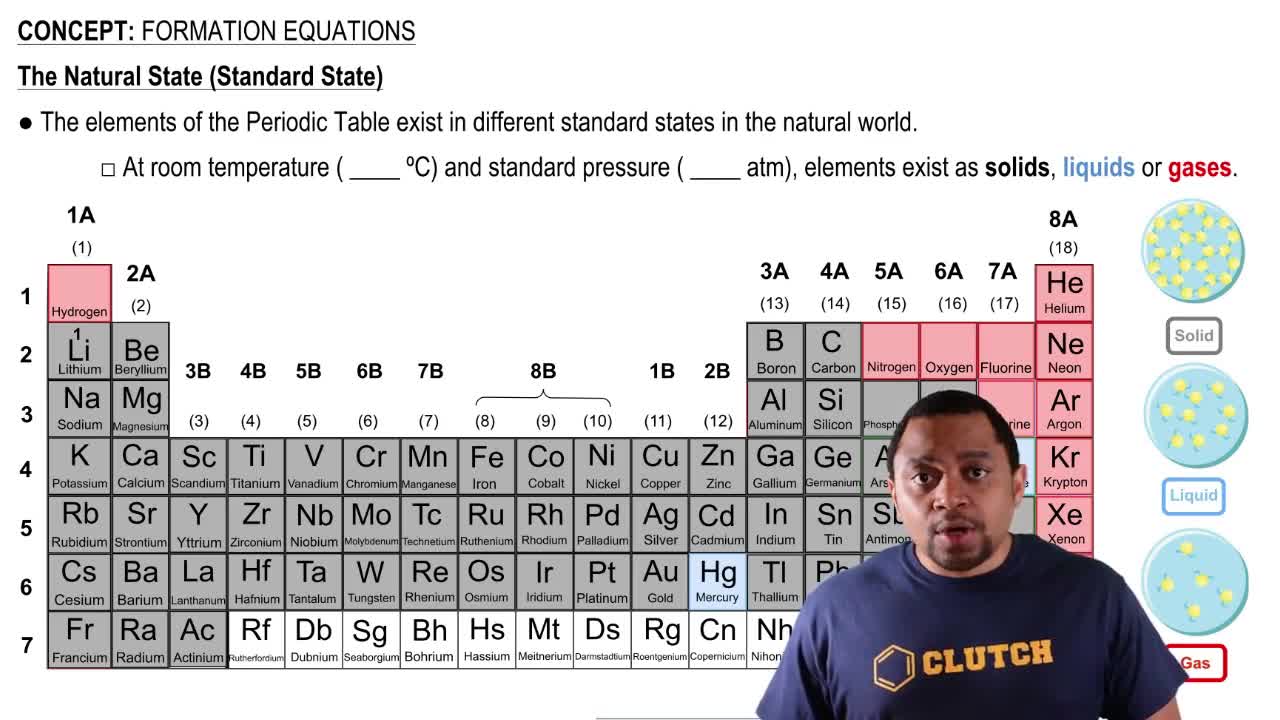
    Elements exist as solids, liquids, or gases at room temperature (25°C) and standard pressure (1 atm).
  • Which elements are monoatomic gases at room temperature?

    The noble gases, such as helium and radon, are monoatomic gases at room temperature.
  • Name two elements that exist as diatomic gases at room temperature.

    Hydrogen (H2) and oxygen (O2) are examples of diatomic gases at room temperature.
  • Which elements exist as liquids at room temperature?

    Bromine (Br2) and mercury (Hg) are the only elements that exist as liquids at room temperature.
  • Is bromine monoatomic or diatomic in its liquid state?

    Bromine is diatomic (Br2) in its liquid state.
  • How does mercury exist in its liquid state at room temperature?

    Mercury exists as a monoatomic liquid (Hg) at room temperature.
  • What is the natural state of most elements on the periodic table?

    Most elements exist as monoatomic solids in their natural state.
  • Which elements exist as polyatomic molecules in their standard state?

    Phosphorus (P4), sulfur (S8), selenium (Se8), and tellurium (Te8) exist as polyatomic molecules.
  • What is the standard state formula for phosphorus?

    Phosphorus exists as P4 in its standard state.
  • How does sulfur exist in its standard state?

    Sulfur exists as S8 in its standard state.
  • What is the standard state of iodine at room temperature?

    Iodine exists as a diatomic molecule (I2) at room temperature.
  • Why do some elements not have a defined phase at room temperature and pressure?

    Elements with high atomic masses or those synthesized in laboratories may be too unstable to have a defined phase under standard conditions.
  • How are molecules arranged in the solid phase?

    In solids, molecules are tightly packed together.
  • Describe the molecular arrangement in the liquid phase.

    In liquids, molecules are more free to move around one another.
  • What is the molecular arrangement in the gas phase?

    In gases, molecules are greatly spread apart.