Introduction to Quantum Mechanics quiz #1 Flashcards

Introduction to Quantum Mechanics quiz #1
Control buttons has been changed to "navigation" mode.
1/10
  • Which of the following statements is true about energy quantization at the atomic level?
    At the atomic level, energy is quantized, meaning electrons can only occupy specific energy levels and cannot exist between these levels.
  • Which statement about the quantum mechanical solution for the hydrogen atom is correct?
    The quantum mechanical solution for the hydrogen atom uses quantum numbers to describe the allowed energy levels and positions of its electron.
  • Energy is quantized. What does this mean?
    This means that electrons in atoms can only have certain discrete energy values, not a continuous range.
  • How is the term photon related to the term quantum?
    A photon is a quantum of electromagnetic energy; 'quantum' refers to the smallest discrete unit of energy, and a photon is one such unit for light.
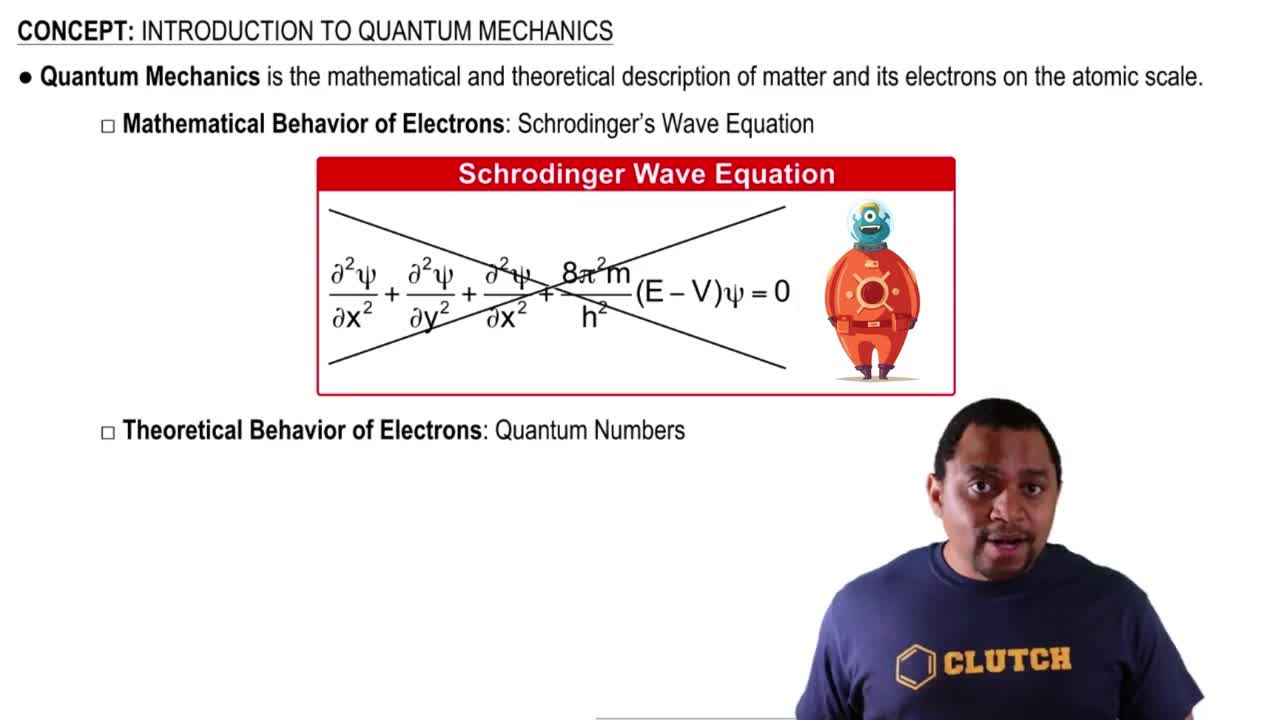
  • Which of the following terms represents the method used to solve the Schrödinger equation?
    The Schrödinger equation is solved using quantum numbers, which describe the energy levels and positions of electrons in atoms.
  • Why is the modern-day quantum model of the atom considered better than John Dalton’s model?
    The quantum model explains the behavior and location of electrons using quantum numbers, providing a more accurate and detailed description than Dalton’s model, which did not account for electron structure.
  • What does the principal quantum number (n) indicate about an electron in an atom?
    The principal quantum number (n) indicates the energy level and size of the shell in which an electron resides.
  • Which quantum number is responsible for describing the shape of an orbital within a subshell?
    The angular momentum quantum number (l), also called the azimuthal quantum number, describes the shape of an orbital within a subshell.
  • What is the role of the magnetic quantum number (ml) in determining an electron's position?
    The magnetic quantum number (ml) specifies the orientation and exact location of an electron within a set of orbitals.
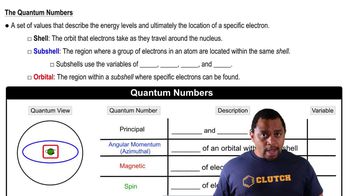
  • How do the four quantum numbers work together to identify an electron in an atom?
    Together, the four quantum numbers allow us to pinpoint the exact location and behavior of a specific electron within an atom, moving from the general shell down to the individual electron.