Isotopes quiz #2 Flashcards

Isotopes quiz #2
Control buttons has been changed to "navigation" mode.
1/40
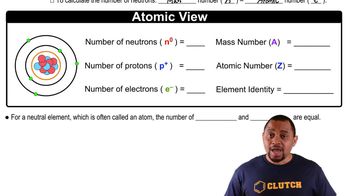
  • How many neutrons are in an atom of sodium (Na) if its mass number is 23 and its atomic number is 11?
    Sodium has 23 - 11 = 12 neutrons.
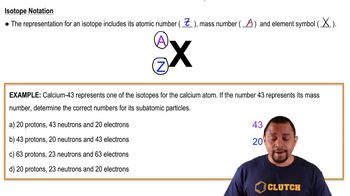
  • How many neutrons does lithium-8 have?
    Lithium-8 has 8 - 3 = 5 neutrons.
  • How do isotopes differ from each other?
    Isotopes differ in the number of neutrons they have.
  • How many neutrons are in lithium-8?
    Lithium-8 has 8 - 3 = 5 neutrons.
  • How many neutrons are in lithium if its mass number is 7 and its atomic number is 3?
    Lithium has 7 - 3 = 4 neutrons.
  • What is the mass number for lithium if it has 3 protons and 4 neutrons?
    The mass number is 3 + 4 = 7.
  • How many neutrons does a lithium atom have if its mass number is 7 and its atomic number is 3?
    Lithium has 7 - 3 = 4 neutrons.
  • Why did Hershey and Chase use the isotopes 32P and 35S in their experiments?
    They used 32P to label DNA and 35S to label proteins to determine which molecule carried genetic information.
  • What is the mass number of an atom of nitrogen that contains 8 neutrons?
    The mass number is 7 (protons) + 8 (neutrons) = 15.
  • How many neutrons does Na have if its mass number is 23 and its atomic number is 11?
    Sodium has 23 - 11 = 12 neutrons.
  • How many neutrons does lithium (Li) have if its mass number is 7 and its atomic number is 3?
    Lithium has 7 - 3 = 4 neutrons.
  • If an organism has 50 chromosomes in a diploid cell, what is the haploid number?
    The haploid number is 50 / 2 = 25.
  • Which of the following statements best describes isotopes? Options: A) Isotopes have different numbers of protons. B) Isotopes have the same mass number. C) Isotopes have different numbers of neutrons. D) Isotopes have different chemical properties.
    C) Isotopes have different numbers of neutrons.
  • How many more neutrons are in an isotope of carbon-14 than in a standard carbon atom?
    Carbon-14 has 8 neutrons, while carbon-12 has 6 neutrons, so there are 2 more neutrons.
  • Which of the following statements describes an isotope? Options: A) Isotopes have different numbers of protons. B) Isotopes have the same mass number. C) Isotopes have different numbers of neutrons. D) Isotopes have different chemical properties.
    C) Isotopes have different numbers of neutrons.
  • How do isotopes differ from each other in terms of atomic structure?
    Isotopes differ in the number of neutrons in their nuclei.
  • If you were to change the amount of neutrons in an atom's nucleus, what would you create?
    You would create an isotope of the element.
  • Isotopes differ from each other in what way?
    Isotopes differ in the number of neutrons they contain.
  • How are the atomic structures of carbon-12 and carbon-14 different from each other?
    Carbon-12 and carbon-14 both have 6 protons, but carbon-12 has 6 neutrons while carbon-14 has 8 neutrons.
  • What makes isotopes different from each other?
    Isotopes differ in the number of neutrons in their nuclei.
  • Which of the following statements best describes an isotope?
    Isotopes are atoms of the same element with the same number of protons but different numbers of neutrons.
  • Lithium has 3 protons. How many neutrons are in the isotope lithium-8?
    Lithium-8 has 5 neutrons.
  • How many neutrons does this atom have if its mass number is 14 and atomic number is 4?
    It has 10 neutrons.
  • Boron occurs naturally as two isotopes. What is the difference between these isotopes?
    They have different numbers of neutrons.
  • What is true about all uranium atoms?
    All uranium atoms have 92 protons.
  • If a fluorine atom has a mass number of 19, how many neutrons does it have?
    It has 10 neutrons.
  • How can you calculate the number of neutrons (n) in an atom?
    Subtract the atomic number from the mass number: n = A - Z.
  • What element with a mass number of 100 has 56 neutrons in its nucleus?
    Ruthenium (Ru), atomic number 44.
  • Which of the following best describes an isotope?
    An atom with the same number of protons but a different number of neutrons.
  • An isotope of the element fluorine has 9 protons and 10 neutrons. What is the name of this isotope?
    Fluorine-19.
  • What is the total number of neutrons in an atom of K-42?
    K-42 has 23 neutrons.
  • How does one isotope differ from another?
    By the number of neutrons in the nucleus.
  • What are the stable isotopes of nitrogen?
    Nitrogen-14 and nitrogen-15.
  • Which of the following pairs are isotopes of each other?
    Atoms with the same atomic number but different mass numbers.
  • Which pair of atoms constitutes a pair of isotopes of the same element?
    Atoms with the same number of protons but different numbers of neutrons.
  • How many neutrons does iron have?
    Iron-56 has 30 neutrons.
  • What happens if an atom loses a neutron?
    It becomes a different isotope of the same element.
  • What is the identity of an atom that contains six protons and eight neutrons?
    Carbon-14.
  • Can the atomic mass of an element vary?
    Yes, due to the presence of different isotopes.
  • How many neutrons does cobalt have?
    Cobalt-59 has 32 neutrons.