Isotopes quiz #5 Flashcards

Isotopes quiz #5
Control buttons has been changed to "navigation" mode.
1/40
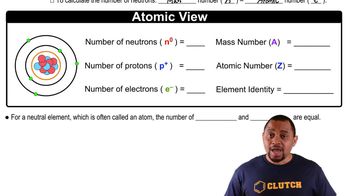
  • How many neutrons are in a typical oxygen atom?
    Oxygen-16 has 8 neutrons.
  • How do isotopes of a given element differ?
    They differ in the number of neutrons.
  • Which of the following represent isotopes?
    Atoms with the same atomic number but different mass numbers.
  • In which of the following sets do all species have the same number of protons?
    Isotopes of the same element.
  • How do the isotopes of a given element differ from one another?
    By the number of neutrons in the nucleus.
  • A neutral argon atom has how many neutrons?
    Argon-40 has 22 neutrons.
  • What isotope has 18 protons and 22 neutrons?
    Argon-40.
  • How many neutrons does zinc have?
    Zinc-65 has 35 neutrons.
  • How do isotopes of a given element differ? How are they similar?
    They differ in the number of neutrons but have the same number of protons.
  • How do the isotopes of an element differ?
    They have different numbers of neutrons.
  • How many neutrons does argon (Ar) have?
    Argon-40 has 22 neutrons.
  • How many neutrons does lithium-6 have?
    Lithium-6 has 3 neutrons.
  • An atom has 10 protons and 10 neutrons. Which of the following is an isotope to this atom?
    An atom with 10 protons and a different number of neutrons (e.g., 10 protons and 11 neutrons).
  • Which of the following atoms has the smallest number of neutrons?
    Hydrogen-1 (protium) has 0 neutrons.
  • Which isotope has the greatest number of protons?
    Uranium-238 has 92 protons.
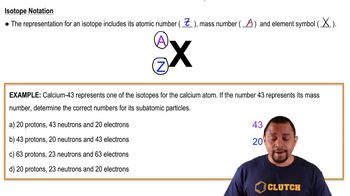
  • In isotope notation, what do the numbers represent?
    The upper number is the mass number; the lower is the atomic number.
  • Deuterium is an isotope of hydrogen. It has a mass number of two. Which describes a deuterium atom?
    Deuterium has 1 proton and 1 neutron.
  • How many neutrons does neon have?
    Neon-20 has 10 neutrons.
  • Give the nuclear symbol for the isotope of silicon for which A=29.
    29Si.
  • How many protons does nitrogen-15 have?
    Nitrogen-15 has 7 protons.
  • How many protons does lithium-6 have?
    Lithium-6 has 3 protons.
  • How many protons does this isotope of titanium have?
    Titanium has 22 protons.
  • How many neutrons are in an isotope of selenium-83?
    Selenium-83 has 49 neutrons.
  • Which symbols represent atoms that are isotopes?
    Atoms with the same atomic number but different mass numbers.
  • How many neutrons are in an atom of tin?
    Tin-120 has 70 neutrons.
  • How many neutrons are contained in Ru-101?
    Ru-101 has 57 neutrons.
  • What isotope has 13 protons and 14 neutrons?
    Aluminum-27.
  • What is the mass number of zinc-63?
    The mass number is 63.
  • How many neutrons are in the nucleus of an atom with an atomic number of 25?
    Depends on the mass number; for Mn-55, there are 30 neutrons.
  • How do you find the number of neutrons in an atom?
    Subtract the atomic number from the mass number.
  • What is the atomic number of all calcium isotopes?
    Calcium has atomic number 20.
  • Which property of the isotopes must be different?
    The number of neutrons.
  • For a radioactive isotope like uranium-235, what makes it radioactive?
    It has an unstable nucleus due to its neutron-to-proton ratio.
  • How many neutrons are in tin-124?
    Tin-124 has 74 neutrons.
  • How many protons (p) and neutrons (n) are in an atom of calcium-46?
    Calcium-46 has 20 protons and 26 neutrons.
  • How many neutrons does krypton have?
    Krypton-84 has 48 neutrons.
  • Which of the following three main isotopes of carbon are also ions?
    Isotopes are neutral unless specified as ions.
  • How can an isotope like carbon-14 be used to date dead organisms?
    Carbon-14 decays at a known rate, allowing age determination by measuring its ratio to carbon-12.
  • What is unique about the number of neutrons in a normal hydrogen atom?
    Normal hydrogen (protium) has no neutrons.
  • Which isotope is not possible?
    An isotope with more protons than neutrons for heavy elements is generally not possible.