Isotopes quiz #6 Flashcards

Isotopes quiz #6
Control buttons has been changed to "navigation" mode.
1/40
  • Two atoms that are isotopes of one another must have a different number of what?
    Neutrons.
  • An atom has an atomic number of 6 and a mass number of 14. How many neutrons does this atom have?
    It has 8 neutrons.
  • How many neutrons are in the nucleus of a germanium (Ge) atom with a mass number of 73?
    Germanium-73 has 41 neutrons.
  • How many neutrons are contained in Mo-96?
    Mo-96 has 54 neutrons.
  • How many neutrons does barium have?
    Barium-138 has 82 neutrons.
  • How many neutrons does sulfur have?
    Sulfur-32 has 16 neutrons.
  • Are two atoms of the same element identical?
    Not always; they may be isotopes with different numbers of neutrons.
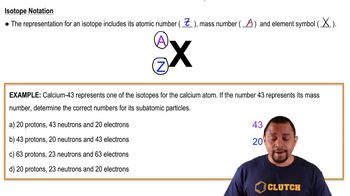
  • What does the number next to isotopes signify?
    It is the mass number (protons plus neutrons).
  • How many neutrons are in argon?
    Argon-40 has 22 neutrons.
  • How many neutrons does lead have?
    Lead-208 has 126 neutrons.
  • How many neutrons are in lead?
    Lead-208 has 126 neutrons.
  • How many neutrons does mercury have?
    Mercury-202 has 122 neutrons.
  • What is the symbol for an atom containing 20 protons and 22 neutrons?
    42Ca (Calcium-42).
  • How many neutrons are present in tin-118?
    Tin-118 has 68 neutrons.
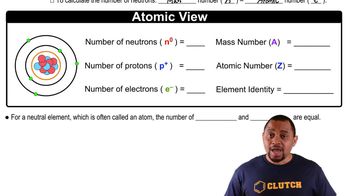
  • How is the number of neutrons in the nucleus of an atom calculated?
    Subtract the atomic number from the mass number.
  • What is the atomic number of the two isotopes of nitrogen?
    Both have atomic number 7.
  • Which of the following oxygen isotopes is the most common?
    Oxygen-16.
  • Which atom has the largest number of neutrons?
    Lead-208 has 126 neutrons.
  • How many neutrons are contained in germanium-75?
    Germanium-75 has 43 neutrons.
  • How does one isotope of a particular element differ from another of the same element?
    By the number of neutrons.
  • How many neutrons are present in the nucleus of an isotope of phosphorus with a mass number of 32?
    Phosphorus-32 has 17 neutrons.
  • How many neutrons does arsenic have?
    Arsenic-75 has 42 neutrons.
  • How many neutrons does the element argon have?
    Argon-40 has 22 neutrons.
  • How are isotopes of a given element similar?
    They have the same number of protons.
  • Which isotopes would you expect to be stable?
    Isotopes with balanced neutron-to-proton ratios, like 12C, 16O, 14N.
  • Magnesium-25 has how many protons and neutrons?
    Magnesium-25 has 12 protons and 13 neutrons.
  • What is the most abundant isotope for nitrogen?
    Nitrogen-14.
  • How many neutrons does bismuth have?
    Bismuth-209 has 126 neutrons.
  • How many neutrons are there in an atom of Kr?
    Krypton-84 has 48 neutrons.
  • The diagram shows three isotopes. What element is represented?
    The element is identified by the number of protons shown.
  • What are stable isotopes?
    Isotopes that do not undergo radioactive decay.
  • How many neutrons does beryllium (Be) have?
    Beryllium-9 has 5 neutrons.
  • How many neutrons are in an atom of Hg-201?
    Hg-201 has 121 neutrons.
  • How many protons and neutrons are in one atom of 30Si?
    30Si has 14 protons and 16 neutrons.
  • How many neutrons does fluorine have?
    Fluorine-19 has 10 neutrons.
  • Which property of argon makes it useful for potassium-argon dating?
    Argon is a noble gas and does not react chemically, so it remains trapped in minerals.
  • Which characteristic of potassium makes it useful for dating rocks?
    Potassium-40 is radioactive and decays to argon-40 at a known rate.
  • How many neutrons are there in 226Ra?
    226Ra has 138 neutrons.
  • Why do different isotopes of an element generally have the same physical and chemical properties?
    Because they have the same number of protons and electrons.
  • What is the name of this specific silicon isotope?
    Silicon-29.