Isotopes quiz #8 Flashcards

Isotopes quiz #8
Control buttons has been changed to "navigation" mode.
1/34
  • An example of a radioactive isotope is carbon-12, carbon-14, neon-20, neon-22.
    Carbon-14 is a radioactive isotope.
  • Its most common isotope has 5 neutrons. What element is this?
    Boron (B).
  • Isotopes of an element will always differ in __________.
    The number of neutrons.
  • All isotopes of oxygen must have
    8 protons.
  • The atoms of different phosphorus isotopes _____.
    Have the same number of protons but different numbers of neutrons.
  • Isotopes are atoms that have the same ________ but differing ________.
    Same number of protons; differing numbers of neutrons.
  • Fluorine-18 undergoes beta-plus decay. The child isotope has an atomic mass of
    18 (mass number remains the same).
  • Which pair below describes isotopes of the same element?
    Atoms with the same atomic number but different mass numbers.
  • Isotopes of an element differ from one another in the number of they contain.
    Neutrons.
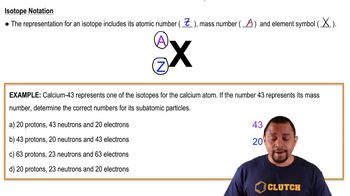
  • The correct symbol for the isotope of potassium with 22 neutrons is ________.
    42K.
  • An atom of chlorine and an atom of bromine have the same
    Number of valence electrons (if in the same group), but not the same number of protons.
  • A rock that contains equal amounts of potassium-40 and argon-40. What does this indicate?
    The rock is about one half-life old for potassium-40.
  • Practice isotope calculations #2: If an atom has atomic number 8 and mass number 18, how many neutrons does it have?
    It has 10 neutrons.
  • A particular isotope of plutonium has 94 protons, neutrons, and a mass number of 241. How many neutrons does it have?
    Plutonium-241 has 147 neutrons.
  • If the natural abundance of Br-79 is 50.69%, what is the natural abundance of Br-81?
    Br-81 has a natural abundance of 49.31%.
  • Based on your answer in part b, how many electrons are in this amount of 13C?
    Each 13C atom has 6 electrons if neutral.
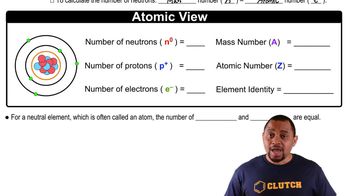
  • An atom of the isotope Cs-133 contains how many protons (p), neutrons (n), and electrons (e)?
    55 protons, 78 neutrons, 55 electrons.
  • What are the factors that affect the average atomic mass of a mixture of isotopes?
    The relative abundances and masses of the isotopes.
  • Which of the following is not a very long-lived, radioactive isotope?
    Carbon-14 is not very long-lived compared to uranium-238.
  • Identify the unknown isotope X in the following decays: If an atom loses a neutron and remains the same element, what is X?
    X is an isotope of the same element with one less neutron.
  • Neutral atoms of all isotopes of a given element have the same
    Number of protons and electrons.
  • An oxygen atom with 10 neutrons is which isotope?
    Oxygen-18.
  • For each set of atoms identify the isotopes: If two atoms have the same atomic number but different mass numbers, what are they?
    They are isotopes of the same element.
  • The iodine isotope with 74 neutrons is which isotope?
    Iodine-127.
  • Choose the correct conditions under which two atoms are different isotopes of the same element.
    Same atomic number, different mass numbers.
  • Gas with 48 neutrons: Which element and isotope is this?
    Krypton-84.
  • Triply charged uranium-235 and uranium-238: How do their numbers of neutrons compare?
    Uranium-235 has 143 neutrons; uranium-238 has 146 neutrons.
  • 12C is stable and relatively tightly bound; this nuclide is the most common form of natural carbon. What does this mean?
    Carbon-12 is the most abundant and stable isotope of carbon.
  • An atom with 2 protons and 4 neutrons is which isotope?
    Helium-6.
  • On another planet the isotopes of titanium: What would be the same among them?
    All would have 22 protons.
  • The correct symbol for the isotope of potassium with 22 neutrons is
    42K.
  • How many protons, neutrons and electrons are there in a neutral atom of the isotope represented by: 14C?
    6 protons, 8 neutrons, 6 electrons.
  • Gallium has two naturally occurring isotopes. What do they have in common?
    They have the same number of protons.
  • A neutral isotope has a mass number of 65 and 36 neutrons. What is the element?
    Zinc (Zn), atomic number 29.