Kinetic Molecular Theory quiz #1 Flashcards

Kinetic Molecular Theory quiz #1
Control buttons has been changed to "navigation" mode.
1/40
  • Which postulate of the kinetic molecular theory best explains why gases can be compressed?

    The postulate stating that the volume of gas particles is negligible compared to the container explains why gases can be compressed.
  • Which is a postulate of the kinetic-molecular theory?

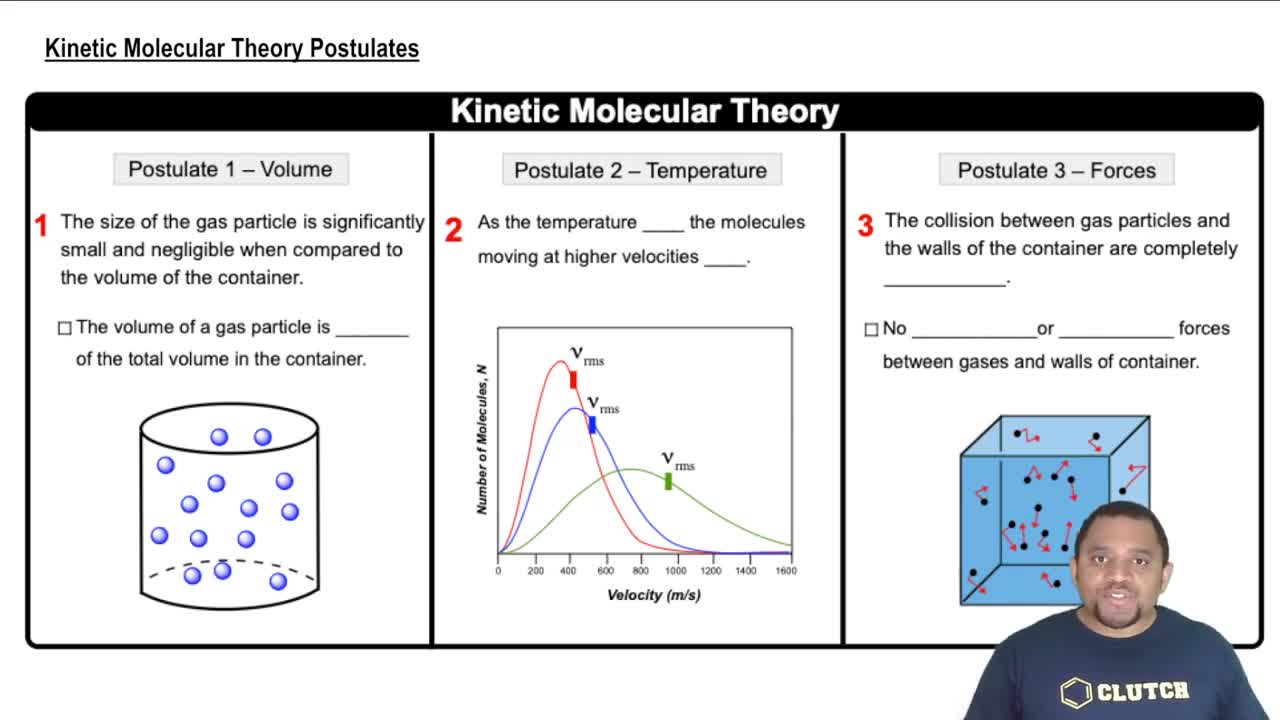
    Gas particles have negligible volume compared to the container, move at speeds dependent on temperature, and experience elastic collisions with no attractive or repulsive forces.
  • Which factor determines the direction and degree of diffusion of a gas?

    The speed and random motion of gas molecules determine the direction and degree of diffusion.
  • Which describes the forces among the particles of an ideal gas?

    There are no attractive or repulsive forces among the particles of an ideal gas.
  • What is the major defining property of gases?

    Gases have particles that are far apart and move freely, allowing them to fill any container.
  • Which of the following is not a postulate of the kinetic molecular theory?

    Gas particles have significant volume compared to the container is not a postulate of the kinetic molecular theory.
  • Which object has molecules that are moving?

    All objects have molecules that are moving, as molecular motion occurs in all states of matter.
  • Which of the following gas samples have the greatest average molecular speed at 25°C?

    The gas sample with the lowest molar mass will have the greatest average molecular speed at 25°C.
  • What happens to molecules when their kinetic energy decreases?

    When kinetic energy decreases, molecules move more slowly.
  • How do molecules in a gas compare to those in a solid?

    Gas molecules are far apart and move freely, while solid molecules are closely packed and vibrate in place.
  • Which phase of water has the greatest amount of kinetic energy?

    Water vapor (gas phase) has the greatest amount of kinetic energy.
  • Which of the following best describes molecular motion?

    Molecules move randomly in all directions and at different speeds.
  • How do the molecules of a gas behave?

    Gas molecules move rapidly and randomly, colliding elastically with each other and the container walls.
  • What is the movement of particles in all directions and at different speeds?

    This describes the random motion of gas molecules.
  • Which of these is a postulate of kinetic molecular theory?

    Gas particles experience elastic collisions with no attractive or repulsive forces.
  • How does rate of diffusion depend on the speed of molecular motion?

    The rate of diffusion increases as the speed of molecular motion increases.
  • What is the effect of temperature on average speed of the particles?

    As temperature increases, the average speed of the particles increases.
  • As the number of collisions of an ideal gas increases, what happens?

    As the number of collisions increases, the pressure exerted by the gas increases.
  • What happens to gas particles when a gas is heated?

    When a gas is heated, its particles move faster due to increased kinetic energy.
  • Which statement is true according to the kinetic theory?

    Gas particles move rapidly and randomly, and their collisions are elastic.
  • Why do gases diffuse faster than liquids?

    Gases diffuse faster because their particles move more rapidly and are farther apart than in liquids.
  • What will happen if the molecules increase their speed?

    If molecules increase their speed, the temperature and pressure of the gas will increase.
  • Which phase of matter has the most kinetic energy?

    The gas phase has the most kinetic energy.
  • Which form of energy is associated with the random motion of particles in a gas?

    Thermal energy is associated with the random motion of particles in a gas.
  • How do gases compare with liquids and solids in terms of the distance between their molecules?

    Gas molecules are much farther apart than those in liquids and solids.
  • How do gas particles exert pressure?

    Gas particles exert pressure by colliding with the walls of their container.
  • What is generally true about the particles in a gas?

    Gas particles move rapidly, are far apart, and have negligible volume compared to the container.
  • What causes a gas to exert pressure?

    Pressure is caused by gas particles colliding with the container walls.
  • Which best describes the motion of molecules in the gaseous state?

    Molecules in the gaseous state move rapidly and randomly in all directions.
  • What aspect of the kinetic theory of gases tells us that the gases will mix?

    The random and rapid motion of gas particles causes gases to mix.
  • How are temperature and kinetic energy related?

    Temperature is directly proportional to the average kinetic energy of particles.
  • What does a decrease in temperature indicate about the molecules in a sample of liquid water?

    A decrease in temperature means the molecules have less kinetic energy and move more slowly.
  • How is temperature related to kinetic energy?

    Temperature measures the average kinetic energy of the particles in a substance.
  • Which model shows the structure and movement of particles in a liquid?

    A model showing particles close together but able to move past each other represents a liquid.
  • How do the particles in a gas move?

    Gas particles move rapidly, randomly, and in straight lines until they collide.
  • What are the 3 main points of the kinetic molecular theory of gases?

    1) Gas particles have negligible volume, 2) Their speed increases with temperature, 3) Collisions are elastic with no attractive or repulsive forces.
  • Which of the following is a postulate of the kinetic molecular theory?

    Gas particles experience elastic collisions with container walls and each other.
  • Which of the following statements is true about kinetic molecular theory?

    Gas particles move rapidly and randomly, and their collisions are elastic.
  • Which is not an assumption of matter made by the kinetic molecular theory of gases?

    Gas particles have significant volume compared to the container is not an assumption.
  • How does kinetic molecular theory explain gas pressure inside a balloon?

    Gas pressure is explained by particles colliding elastically with the balloon walls.