Kinetic Molecular Theory quiz #2 Flashcards
Kinetic Molecular Theory quiz #2
You can tap to flip the card.
Control buttons has been changed to "navigation" mode.
1/40
What must be true about a gas for Boyle's and Charles' laws to be applicable?
The gas must behave ideally, with negligible particle volume and no intermolecular forces.What causes gas pressure in a container such as a helium balloon?
Gas pressure is caused by helium molecules colliding with the container walls.Which statement is true about kinetic molecular theory?
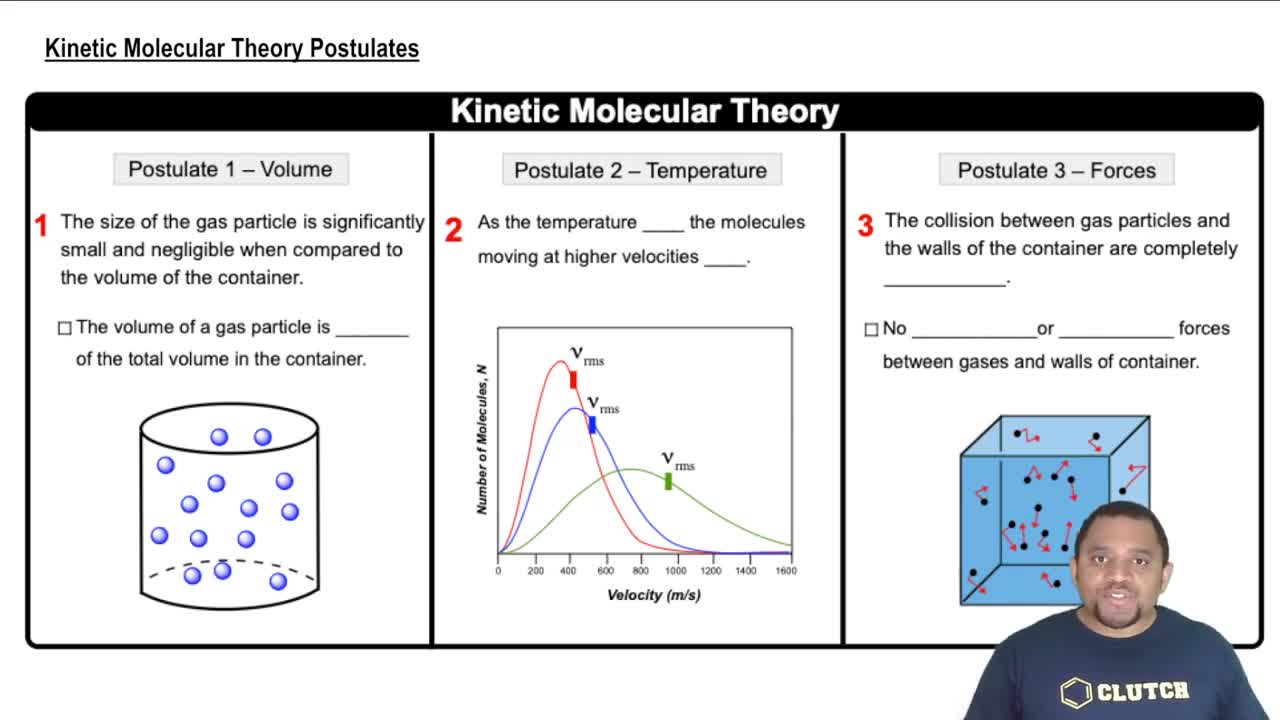
Gas particles move rapidly, are far apart, and experience elastic collisions.What assumption does the kinetic molecular theory make about particle size for ideal gases?
The theory assumes gas particles have negligible volume compared to the container.Which is not an assumption of the kinetic molecular theory?
Gas particles have significant attractive forces is not an assumption.How is the temperature of an object related to the average kinetic energy of its particles?
Temperature is a measure of the average kinetic energy of the particles.Which gas has molecules with the greatest average kinetic energy at 25°C?
All gases at the same temperature have the same average kinetic energy.Which gas has molecules with the greatest average molecular speed at 25°C?
The gas with the lowest molar mass has the greatest average molecular speed at 25°C.The molecules in which of the following have the greatest average molecular kinetic energy?
The sample at the highest temperature has the greatest average molecular kinetic energy.Which of the following is not one of the postulates of the kinetic molecular theory for ideal gases?
Gas particles have significant volume is not a postulate.Which property of gases is explained by the process of diffusion?
The random motion and spacing of gas particles explain diffusion.What do the faster-moving molecules have more of that causes them to move faster?
Faster-moving molecules have more kinetic energy.Which of the following describes what happens as the temperature of a gas in a balloon increases?
As temperature increases, gas molecules move faster and exert more pressure.Why is it possible to compress a gas?
Gases can be compressed because their particles are far apart and have negligible volume.How does a gas exert pressure?
A gas exerts pressure by its particles colliding with the container walls.Which describes the path of a gas particle between collisions with other particles?
Gas particles travel in straight lines between collisions.Which statement does the kinetic theory explain?
The kinetic theory explains why gases exert pressure and fill their containers.Which statement is consistent with the kinetic-molecular theory?
Gas particles move rapidly and randomly, and their collisions are elastic.Which of these statements describe the postulate of kinetic molecular theory?
Gas particles have negligible volume and experience elastic collisions.Which of the following statements is not correct for the kinetic-molecular theory of gases?
Gas particles have significant attractive forces is not correct.As explained by kinetic molecular theory, what happens when temperature increases?
As temperature increases, the speed and kinetic energy of gas particles increase.Which is a postulate of the kinetic molecular theory of gases?
Collisions between gas particles and container walls are elastic.What is different about the way molecules move in gases?
Gas molecules move rapidly and randomly, unlike solids and liquids.If the molecules of a sample speed up, what happens?
If molecules speed up, the temperature and pressure of the sample increase.Why are gases easy to compress?
Gases are easy to compress because their particles are far apart and occupy negligible volume.What happens to the speed of the molecules when the temperature decreases?
When temperature decreases, the speed of the molecules decreases.What determines the speed of the atoms and molecules of a particular substance?
The temperature of the substance determines the speed of its atoms and molecules.Why do gases compress more easily than liquids and solids?
Gases compress more easily because their particles are much farther apart.What happens to particles as they heat up?
As particles heat up, their kinetic energy and speed increase.What is the average translational kinetic energy of a nitrogen molecule at STP?
The average translational kinetic energy is proportional to the temperature, regardless of the gas type.What happens to the molecules of a gas when the gas is heated?
When a gas is heated, its molecules move faster and have more kinetic energy.What is the average speed vavg of the molecules in the gas?
The average speed depends on the temperature and the molar mass of the gas.What 3 things can molecules moving with kinetic energy do?
Molecules can move, collide elastically, and exert pressure on container walls.If you double the typical speed of the molecules in a gas, what happens?
Doubling the speed increases the kinetic energy and pressure exerted by the gas.Which statement best describes the compressibility of a gas?
Gases are highly compressible due to the large spaces between particles.Which statement best describes the atoms in a gas?
Atoms in a gas are far apart and move rapidly in all directions.Which statement describes a limitation of the kinetic-molecular theory for a gas?
The theory assumes no intermolecular forces, which is not true for real gases.Which postulate of the kinetic-molecular theory applies to the particles of a liquid?
Liquids have particles that are close together but can move past each other, unlike gases.Which statement describes the particles of an ideal gas?
Ideal gas particles have negligible volume and no attractive or repulsive forces.Which phrase describes the motion and attractive forces of ideal gas particles?
Ideal gas particles move rapidly and experience no attractive or repulsive forces.