Control buttons has been changed to "navigation" mode.
1/10
Terms in this set (10)
Which state of matter—gases, liquids, or solids—has the least potential energy?
Solids have the least potential energy because their particles are closely packed and have minimal positional energy compared to liquids and gases.
How do you measure the amount of energy an object has?
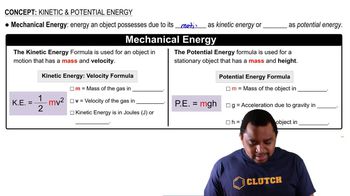
The amount of energy is measured in joules (J) using formulas: kinetic energy (KE = 1/2 mv^2) for motion and potential energy (PE = mgh) for position.
Arrange the potential energy of particles in solids, liquids, and gases from least to greatest.
Potential energy increases from solids (least), to liquids, to gases (greatest).
What happens to the kinetic energy of molecules when you transfer energy into a substance?
When energy is transferred into a substance, the molecules' kinetic energy increases, causing them to move faster.
What is the relationship between kinetic energy and potential energy in terms of mechanical energy?
Kinetic energy and potential energy together make up mechanical energy, which is the total energy due to an object's motion and position.
What are the units of kinetic energy and how are they derived from its formula?
Kinetic energy is measured in joules (J), which are derived as kilograms times meters squared per seconds squared (kg·m²/s²) from the formula KE = 1/2 mv².
What value is typically used for acceleration due to gravity when calculating potential energy on Earth?
The acceleration due to gravity on Earth is typically taken as 9.8 meters per second squared (m/s²) in potential energy calculations.
How can you convert between kinetic energy and potential energy for an object?
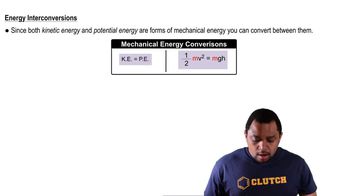
You can convert between kinetic and potential energy by setting their formulas equal, using the same mass and solving for either velocity or height as needed.
In the formula for potential energy, what does the variable 'h' represent and what are its units?
'h' represents the height of the object above a reference point, and its units are meters (m).
What does the variable 'v' stand for in the kinetic energy formula, and what does squaring it signify?
'v' stands for velocity in meters per second, and squaring it means the energy increases rapidly as the object's speed increases.