Law of Conservation of Mass quiz #1 Flashcards

Law of Conservation of Mass quiz #1
Control buttons has been changed to "navigation" mode.
1/40
  • What does the law of conservation of matter state?

    It states that matter cannot be created or destroyed in a chemical reaction; it only changes form.
  • What does the law of conservation of mass state?

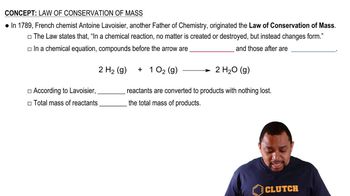
    The law states that mass is neither created nor destroyed during a chemical reaction; the total mass of reactants equals the total mass of products.
  • What was Antoine Lavoisier's contribution to the law of conservation of mass?

    Lavoisier established the law of conservation of mass, showing that mass is conserved in chemical reactions.
  • Which equation best represents the law of conservation of mass?

    A balanced chemical equation, such as H2 + O2 → H2O, where the total mass of reactants equals the total mass of products.
  • What happens to atoms during a chemical reaction?

    Atoms are rearranged to form new substances, but they are not created or destroyed.
  • What does the law of conservation of matter tell us?

    It tells us that the total amount of matter remains constant during physical and chemical changes.
  • What is the law that ensures that chemical reactions are balanced?

    The law of conservation of mass ensures chemical equations are balanced.
  • What happens to the atoms in a chemical reaction?

    Atoms are rearranged into new combinations, but their total number remains unchanged.
  • How does a balanced chemical equation satisfy the law of conservation of mass?

    It shows equal numbers of each type of atom on both sides, ensuring mass is conserved.
  • Are the number of atoms before and after a chemical reaction the same? Why?

    Yes, because atoms are not created or destroyed, only rearranged.
  • What happens to atoms in a chemical reaction?

    Atoms are rearranged to form new molecules, but their total number stays the same.
  • What is the law of conservation of matter?

    It is the principle that matter cannot be created or destroyed in a chemical reaction.
  • What is the equation for the law of conservation of mass?

    Total mass of reactants = Total mass of products.
  • What happens to the atoms during a chemical reaction?

    They are rearranged into new substances, but their total number is conserved.
  • How does the balanced equation relate to the law of conservation of matter?

    A balanced equation reflects that the same number of each atom is present before and after the reaction.
  • What does the law of conservation state?

    It states that mass and matter are conserved in chemical reactions.
  • What happens to the total mass of the atoms involved in a chemical reaction?

    The total mass remains unchanged; it is conserved.
  • The law of conservation of mass is best described as which of the following statements?

    Mass is neither created nor destroyed in a chemical reaction.
  • What happens to the atoms of the reactants in a chemical reaction?

    They are rearranged to form products, but their total number is conserved.
  • How do balanced chemical equations show the conservation of mass?

    They show equal numbers of each atom on both sides, indicating mass is conserved.
  • Are atoms created or destroyed in a chemical reaction?

    No, atoms are not created or destroyed; they are only rearranged.
  • Which equation represents a conservation of atoms?

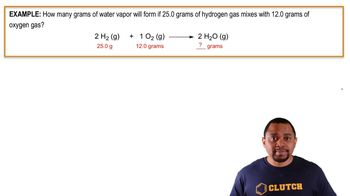
    A balanced equation, such as 2H2 + O2 → 2H2O, conserves atoms.
  • Which equation represents conservation of atoms?

    Any balanced chemical equation, like Mg + 2HCl → H2 + MgCl2.
  • According to the law of conservation of matter, what happens during a chemical reaction?

    Matter is not created or destroyed; it is transformed.
  • What happens to the total mass as the reaction takes place?

    The total mass remains constant throughout the reaction.
  • What is the main principle behind the law of conservation of matter?

    Matter cannot be created or destroyed, only changed in form.
  • The mass of the products of a reaction will always equal what?

    The mass of the reactants.
  • How does the existence of atoms explain the conservation of matter?

    Atoms are indivisible in chemical reactions, so their total number and mass are conserved.
  • How do the atoms before the reaction relate to the atoms after the reaction?

    The same atoms are present; they are just rearranged.
  • Which of the following represent the law of conservation of mass?

    Balanced chemical equations where total mass of reactants equals total mass of products.
  • How do we show that matter is always conserved in a chemical reaction?

    By writing and balancing chemical equations.
  • Which chemical equation best represents the law of conservation of mass?

    2H2 + O2 → 2H2O, with equal numbers of each atom on both sides.
  • What does the law of conservation of charge state?

    Charge is conserved in chemical reactions; the total charge before and after remains the same.
  • According to the law of conservation of mass, what must be true in a chemical reaction?

    The total mass of reactants equals the total mass of products.
  • Which of the following must be the same before and after a chemical reaction?

    The total mass and number of each type of atom.
  • What was one of the tests that Lavoisier performed to prove the law of conservation of mass?

    He measured the mass of reactants and products in a closed system to show they were equal.
  • Which statement best describes the law of conservation of mass?

    Mass is neither created nor destroyed in chemical reactions.
  • What must always be true for a chemical reaction to occur?

    The total mass and number of atoms must be conserved.
  • Which of the following is true regarding the law of conservation of mass?

    It applies to all chemical reactions; mass is always conserved.
  • How can a student determine that a chemical reaction demonstrates the law of conservation of mass?

    By measuring the mass before and after the reaction and confirming they are equal.