Law of Conservation of Mass quiz #3 Flashcards
Law of Conservation of Mass quiz #3
You can tap to flip the card.
Control buttons has been changed to "navigation" mode.
1/40
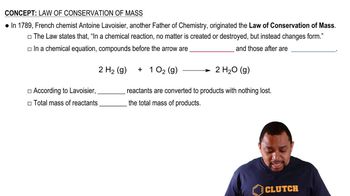
Which is a statement of the law of conservation of mass?
Mass is neither created nor destroyed in a chemical reaction.What quantity remains unchanged in a chemical reaction?
Total mass.Which is true of mass during a chemical reaction?
Mass is conserved.Which best explains why conservation of mass should be studied in a closed system?
To prevent loss or gain of matter from the surroundings, ensuring accurate measurement.Which of the following statements best defines the law of conservation of mass?
Mass is neither created nor destroyed in a chemical reaction.All mass is conserved in a chemical reaction. What law does this represent?
The law of conservation of mass.What does the law of conservation of mass say about matter?
Matter is not created or destroyed; it is conserved.Which chemical equation satisfies the law of conservation of mass?
Any balanced equation, such as 2H2 + O2 → 2H2O.Which of the following chemical equations follows the law of conservation of mass?
Balanced equations, like Mg + 2HCl → H2 + MgCl2.Which observation illustrates the law of conservation of mass?
The total mass before and after a reaction in a closed system is the same.Why does the mass of a substance remain the same after a chemical reaction?
Because mass is conserved; atoms are only rearranged.What happens to matter during a chemical reaction?
Matter is rearranged into new substances, but not created or destroyed.What occurs during all chemical reactions?
Atoms are rearranged and mass is conserved.How does the concept of conservation of mass apply to chemical reactions?
It ensures the total mass of reactants equals the total mass of products.What is conserved during a chemical reaction?
Mass and number of atoms.What is conserved in a chemical reaction?
Mass and number of atoms.Which equation shows conservation of atoms?
A balanced equation, such as 2H2 + O2 → 2H2O.What is conserved during all chemical reactions?
Mass and number of atoms.Which experiment can be used to model that mass is conserved during a chemical reaction?
A reaction performed in a sealed container, measuring mass before and after.Why is mass conserved in chemical reactions?
Because atoms are not created or destroyed, only rearranged.Which are conserved during a chemical reaction?
Mass and number of atoms.What happens to the mass of substances during a physical change?
The mass remains unchanged.Which of the following gets conserved in chemical reactions?
Mass and number of atoms.What does the conservation of mass say?
Mass is neither created nor destroyed in a chemical reaction.What is conserved in physical changes?
Mass is conserved.Which statement best describes balancing equations and the law of conservation of mass?
Balancing equations ensures mass is conserved in chemical reactions.What does the law of conservation of matter say?
Matter cannot be created or destroyed, only changed in form.Which best describes the law of conservation of mass?
Mass is neither created nor destroyed in a chemical reaction.Which equation obeys the law of conservation of mass?
Any balanced chemical equation.Which of the following drawings depict the law of conservation of matter?
Drawings showing equal numbers of each atom before and after a reaction.Experiment 1: Where did the extra mass come from? (Hint: the final product is magnesium oxide.)
The extra mass comes from oxygen combining with magnesium to form magnesium oxide.What does it mean to say that mass is conserved during a physical change?
The total mass remains the same before and after the change.If there is 8 g of a substance before a physical change, what will the mass be after?
It will still be 8 g.Which property of matter is conserved in chemical reactions and shown by balanced equations?
Mass.Which property of physical changes explains why matter is conserved in a physical change?
Mass is conserved because atoms are not created or destroyed.What do you think would happen to the mass if the reaction took place inside a sealed plastic bag?
The mass would remain the same before and after the reaction.What is conserved in physical changes? Shape, energy, mass, density.
Mass is conserved.Which chemical equation models the law of conservation of mass?
Any balanced equation, such as 2H2 + O2 → 2H2O.What evidence did the team examine that matter is conserved when dry ice changes into a gas?
They measured the mass before and after the change in a closed system.What is always true about the total amount of O2 and CO2 in the test tube?
The total mass remains constant.