Back

Lewis Dot Structures: Exceptions quiz

Control buttons has been changed to "navigation" mode.
1/15
  • What is the octet rule in chemistry?

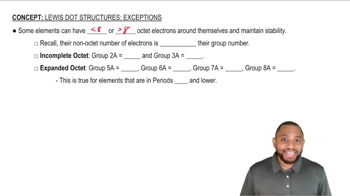
    The octet rule states that atoms tend to combine so that each atom has eight electrons in its valence shell, similar to a noble gas.
  • Which groups can have stable Lewis structures with less than 8 valence electrons?

    Group 2A elements can be stable with 4 valence electrons, and Group 3A elements can be stable with 6 valence electrons.
  • How do you determine the number of electrons for incomplete octets in Groups 2A and 3A?

    Multiply the group number by 2; Group 2A gets 4 electrons and Group 3A gets 6 electrons.
  • What is a free radical in chemistry?

    A free radical is a molecule or ion with an unpaired electron, making it highly reactive.
  • How can you identify a radical from the total number of valence electrons?

    If the total number of valence electrons is odd, the molecule is likely a radical.
  • What is the formula for calculating formal charge?

    Formal charge = group number − number of bonds − nonbonding electrons.
  • Why is it important to minimize formal charges in a Lewis structure?

    A Lewis structure with formal charges close to zero is the most stable representation of a molecule.
  • Where should you place the unpaired electron when drawing a radical's Lewis structure?

    Place the unpaired electron on the atom that results in the least formal charges.
  • What is the expanded octet, and which elements can have it?

    Expanded octet refers to atoms having more than 8 valence electrons, such as 10, 12, 14, or 16, often seen in transition elements.
  • How many valence electrons can Group 5A and 6A elements have in expanded octets?

    Group 5A can have 10 electrons, and Group 6A can have 12, 14, or 16 electrons in expanded octets.
  • What is the significance of an odd number of valence electrons in a molecule?

    An odd number of valence electrons usually indicates the presence of a free radical.
  • What is the relationship between free radicals and cell damage?

    Free radicals are highly reactive and can damage healthy cells in the body.
  • How do you determine the best Lewis structure for a radical?

    Choose the structure where the unpaired electron placement results in the lowest formal charges for all atoms.
  • What group is nitrogen in, and how many valence electrons does it have?

    Nitrogen is in Group 5A and has 5 valence electrons.
  • What group is oxygen in, and how many valence electrons does it have?

    Oxygen is in Group 6A and has 6 valence electrons.