Back

Mass Defect quiz

Control buttons has been changed to "navigation" mode.
1/15
  • What is the mass defect in nuclear chemistry?

    Mass defect is the difference between the predicted mass of an isotope (sum of its subatomic particles) and its actual nuclear mass.
  • Which subatomic particle has the greatest mass: neutron, proton, or electron?

    The neutron has the greatest mass, slightly more than the proton, and both are much heavier than the electron.
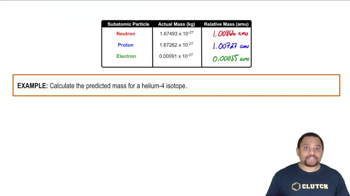
  • What are the relative atomic mass units (amu) for neutrons, protons, and electrons?

    Neutrons are 1.00866 amu, protons are 1.00727 amu, and electrons are 0.00055 amu.
  • Where is most of an atom’s mass located?

    Most of an atom’s mass is located in the nucleus, which contains protons and neutrons.
  • What does the first law of thermodynamics state?

    The first law of thermodynamics states that energy cannot be created or destroyed, only transformed.
  • How is mass defect related to energy?

    The mass lost during isotope formation (mass defect) is converted into energy, as described by E=mc^2.
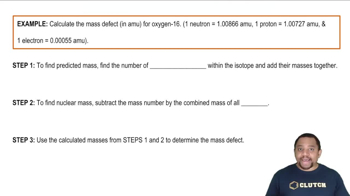
  • What is the predicted mass of an isotope?

    The predicted mass is the sum of the masses of all its neutrons, protons, and electrons.
  • What happens to the mass when subatomic particles combine to form an isotope?

    Some mass is lost during the combination, and this lost mass is converted into energy.
  • What is the nuclear mass of an isotope?

    Nuclear mass is the actual mass of the isotope, typically found on the periodic table as atomic mass.
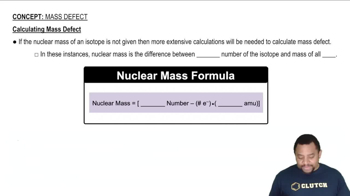
  • How do you calculate nuclear mass if it is not given?

    Nuclear mass equals the mass number minus the number of electrons times their individual mass (0.00055 amu).
  • Why is the predicted mass always greater than the nuclear mass?

    Because some mass is lost and converted into energy during the formation of the isotope.
  • What equation allows conversion between mass and energy?

    Einstein’s equation, E=mc^2, allows conversion between mass and energy.
  • What is the mass defect equation in terms of predicted and nuclear mass?

    Predicted mass minus mass defect equals nuclear mass.
  • What role does energy play in breaking up an isotope into its subatomic particles?

    Energy is absorbed to break up the isotope into its original subatomic particles.
  • What is the atomic mass unit (amu) equivalent in kilograms?

    One atomic mass unit is equal to 1.66 × 10^-27 kilograms.