Molecular Equations quiz #1 Flashcards

Molecular Equations quiz #1
Control buttons has been changed to "navigation" mode.
1/10
  • What is the formula of the precipitate that forms when Pb(NO3)2(aq) and K2SO4(aq) are mixed?
    The formula of the precipitate is PbSO4, which forms as a solid due to its low solubility in water.
  • Which of the following represents the molecular equation for the reaction of NH3 with HI?
    The molecular equation is: NH3(aq) + HI(aq) → NH4I(aq).
  • Which molecules are the products in the following reaction: NaOH + HCl → NaCl + H2O?
    The products are NaCl (an ionic compound) and H2O (water).
  • Which of the following represents the molecular equation for the reaction of HNO3 with CsOH?
    The molecular equation is: HNO3(aq) + CsOH(aq) → CsNO3(aq) + H2O(l).
  • Which of these is a product of the chemical reaction: NiSO4 + K2CO3 → NiCO3 + K2SO4?
    NiCO3 is a product of the reaction.
  • Identify the solid product formed, if any, from the reaction of (NH4)2CO3(aq) and Mg(NO3)2(aq).
    MgCO3 is the solid product formed as a precipitate.
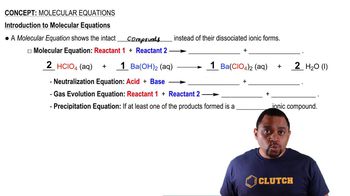
  • What distinguishes a molecular equation from an ionic equation?
    A molecular equation shows all reactants and products as intact compounds, while an ionic equation displays them as their dissociated ions.
  • In a gas evolution reaction, what is a key characteristic of the products formed?
    At least one of the products is a gas, which differentiates it from other types of reactions.
  • What role do solubility rules play in precipitation reactions?
    Solubility rules help determine whether a compound will remain dissolved or form a solid precipitate in a reaction.
  • How can you classify a molecular equation based on its products?
    You can classify it as a neutralization, gas evolution, or precipitation equation depending on whether the products include water, a gas, or a solid.