Back

Molecular Formula quiz

Control buttons has been changed to "navigation" mode.
1/10
  • What is the molecular formula of glucose?

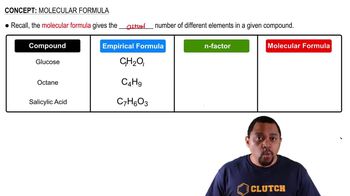
    The molecular formula of glucose is C6H12O6.
  • How does the empirical formula differ from the molecular formula?

    The empirical formula represents the simplest whole-number ratio of elements, while the molecular formula shows the actual number of atoms in a compound.
  • What is the empirical formula of glucose?

    The empirical formula of glucose is CH2O.
  • What is the n factor for glucose when converting its empirical formula to its molecular formula?

    The n factor for glucose is 6.
  • Does the molecule CO2 have the same empirical and molecular formula?

    Both, because the empirical and molecular formulas for CO2 are the same.
  • What is the molecular formula of octane given its empirical formula C4H9?

    The molecular formula of octane is C8H18.
  • How do you determine the molecular formula if the n factor is unknown?

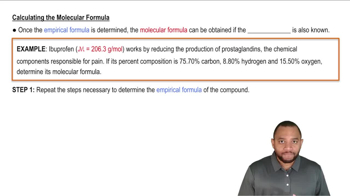
    You need to determine the compound's empirical formula and molar mass to calculate the n factor.
  • What is the n factor for salicylic acid if its empirical and molecular formulas are the same?

    The n factor for salicylic acid is 1.
  • What does the n factor represent in the context of molecular formulas?

    The n factor is a multiplier used to convert an empirical formula to a molecular formula.
  • What is the relationship between empirical and molecular formulas?

    The molecular formula is a multiple of the empirical formula, determined by the n factor.