Back

Molecular Geometry quiz

Control buttons has been changed to "navigation" mode.
1/15
  • What determines the molecular geometry of a compound?

    Molecular geometry is determined by the number of electron groups (bonding groups and lone pairs) around the central atom.
  • How are lone pairs and bonding groups treated when determining molecular geometry?

    Lone pairs and bonding groups are treated differently because lone pairs cause greater repulsion than bonding groups.
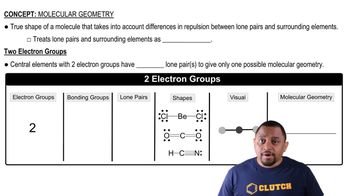
  • What is the molecular geometry when there are 2 electron groups and 0 lone pairs on the central atom?

    The geometry is linear, regardless of whether the bonds are single, double, or triple.
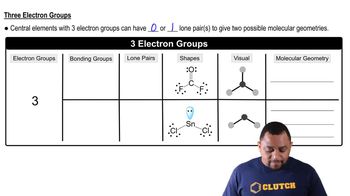
  • What are the possible molecular geometries for a central atom with 3 electron groups?

    The possible geometries are trigonal planar (0 lone pairs) and bent or angular (1 lone pair).
  • What is the molecular geometry called when a central atom has 3 bonding groups and 0 lone pairs?

    The geometry is trigonal planar.
  • What is the molecular geometry called when a central atom has 2 bonding groups and 1 lone pair?

    The geometry is bent, also known as v-shaped or angular.
  • How many possible molecular geometries exist for a central atom with 4 electron groups?

    There are three possible geometries: tetrahedral, trigonal pyramidal, and bent.
  • What is the geometry of methane (CH4) with 4 bonding groups and 0 lone pairs?

    Methane has a tetrahedral molecular geometry.
  • What is the geometry of ammonia (NH3) with 3 bonding groups and 1 lone pair?

    Ammonia has a trigonal pyramidal molecular geometry.
  • What is the geometry of water (H2O) with 2 bonding groups and 2 lone pairs?

    Water has a bent, v-shaped, or angular molecular geometry.
  • How many possible molecular geometries exist for a central atom with 5 electron groups?

    There are four possible geometries: trigonal bipyramidal, seesaw, T-shaped, and linear.
  • What is the geometry called when a central atom has 5 bonding groups and 0 lone pairs?

    The geometry is trigonal bipyramidal.
  • What is the geometry called when a central atom has 4 bonding groups and 1 lone pair?

    The geometry is seesaw.
  • What is the geometry called when a central atom has 3 bonding groups and 2 lone pairs?

    The geometry is T-shaped.
  • What are the three possible molecular geometries for a central atom with 6 electron groups?

    The possible geometries are octahedral (0 lone pairs), square pyramidal (1 lone pair), and square planar (2 lone pairs).