Octet Rule quiz #1 Flashcards
You can tap to flip the card.
Control buttons has been changed to "navigation" mode.
1/40
How many electrons does an atom generally need in its outer shell to be stable according to the octet rule?
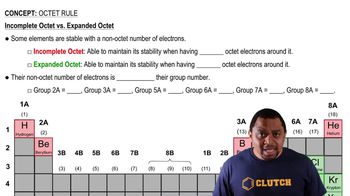
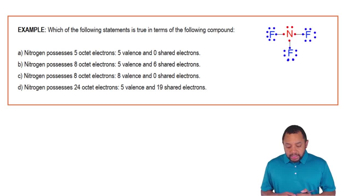
Most atoms need 8 electrons in their outer shell to be stable, following the octet rule.Which compound among H2O, HCl, CCl4, and ClF3 is an exception to the octet rule?
ClF3 is an exception to the octet rule because chlorine can have an expanded octet.What does the octet rule state that explains why atoms bond?
The octet rule states that atoms bond to achieve 8 electrons in their valence shell, gaining stability similar to noble gases.Does this atom satisfy the octet rule? Why or why not? (Assume the atom has 8 valence electrons.)
Yes, the atom satisfies the octet rule because it has 8 valence electrons, which is the stable configuration.What makes noble gases stable?
Noble gases are stable because they naturally have a full valence shell of 8 electrons.How many more electrons does each oxygen atom need to be stable?
Each oxygen atom needs 2 more electrons to reach a stable octet.How does calcium obey the octet rule?
Calcium obeys the octet rule by losing two electrons to achieve a stable configuration like a noble gas.Which of the following molecules contains an atom with an expanded octet?
ClF3 contains an atom (chlorine) with an expanded octet.Oxygen has 6 valence electrons. How many electrons does an atom of oxygen need to become stable?
Oxygen needs 2 more electrons to become stable and satisfy the octet rule.What does the octet rule state?
The octet rule states that atoms tend to have 8 electrons in their valence shell to achieve stability.How many electrons do most atoms want in their valence shell?
Most atoms want 8 electrons in their valence shell.What is the octet rule?
The octet rule is the tendency of atoms to have 8 electrons in their valence shell for stability.How many electrons does it take to fill an octet?
It takes 8 electrons to fill an octet.Which of the following best describes the octet rule?
Atoms tend to gain, lose, or share electrons to have 8 electrons in their outer shell.How does oxygen obey the octet rule?
Oxygen obeys the octet rule by forming two covalent bonds to gain 2 electrons and reach 8 in its valence shell.In which of these bonding patterns does X obey the octet rule? (Assume X forms four single covalent bonds.)
X obeys the octet rule when it forms four single covalent bonds, resulting in 8 electrons in its valence shell.Which of the following atoms best exemplifies the octet rule?
Carbon best exemplifies the octet rule, as it commonly forms four bonds to achieve 8 valence electrons.The octet rule states that atoms want to have how many electrons in their outer shell?
Atoms want to have 8 electrons in their outer shell.In accordance with the octet rule, what do atoms tend to do?
Atoms tend to gain, lose, or share electrons to achieve 8 electrons in their valence shell.How do nonmetals change to obey the octet rule?
Nonmetals typically gain or share electrons to reach 8 electrons in their valence shell.How many is an octet of electrons?
An octet of electrons is 8 electrons.How does sodium obey the octet rule when reacting to form compounds?
Sodium obeys the octet rule by losing one electron to achieve a stable configuration like neon.Which of the following contains an atom that does not obey the octet rule?
BF3 contains boron, which does not obey the octet rule and is stable with only 6 electrons.Atoms of which elements form bonds without satisfying the octet rule?
Hydrogen, helium, beryllium, and boron often form bonds without satisfying the octet rule.How many electrons does oxygen require to reach an octet in its valence shell?
Oxygen requires 2 electrons to reach an octet.Which of the following species will have an expanded octet?
SF6 will have an expanded octet because sulfur can accommodate more than 8 electrons.What are the two ways in which atoms can satisfy the octet rule?
Atoms can satisfy the octet rule by sharing electrons (covalent bonding) or by transferring electrons (ionic bonding).Which compound is likely to have an incomplete octet?
BF3 is likely to have an incomplete octet because boron is stable with only 6 electrons.How many electrons does an atom generally need in its outer level to be the most stable?
An atom generally needs 8 electrons in its outer level to be most stable.How many hydrogen atoms must bond to silicon to give it an octet of valence electrons?
Four hydrogen atoms must bond to silicon to give it an octet of valence electrons.What will oxygen likely do to complete its outermost shell?
Oxygen will likely gain or share 2 electrons to complete its outermost shell.What is the “octet rule”?
The octet rule is the principle that atoms tend to have 8 electrons in their valence shell for stability.Why do atoms form bonds to achieve a full octet in the valence shell?
Atoms form bonds to achieve a full octet because it leads to greater stability, similar to noble gases.How does calcium obey the octet rule when reacting to form compounds?
Calcium obeys the octet rule by losing two electrons, resulting in a stable noble gas configuration.Which elements in the periodic table can have an expanded octet?
Elements in period 3 and below, such as phosphorus, sulfur, and chlorine, can have an expanded octet.Can oxygen expand its octet?
No, oxygen cannot expand its octet because it is in period 2 and lacks available d orbitals.Atoms that satisfy the octet rule are said to be __________.
Atoms that satisfy the octet rule are said to be stable.Can chlorine expand its octet?
Yes, chlorine can expand its octet because it is in period 3.Based on the octet rule, boron will most likely form a ________ ion.
Based on the octet rule, boron will most likely form a 3+ ion by losing three electrons.Atoms whose outer electron shells contain eight electrons tend to:
Atoms whose outer electron shells contain eight electrons tend to be chemically stable and unreactive.