The osmolarity of a cell is 0.3 osm. Which concentration of NaCl solution would be isosmotic to the cell?
A 0.15 M NaCl solution is isosmotic to a cell with 0.3 osmolarity, because NaCl dissociates into 2 ions (Na+ and Cl-), so 0.15 M × 2 = 0.3 osm.
What is a solution called when it has the same solute concentration as another solution?
A solution with the same solute concentration as another is called isosmotic.
What is the osmolarity of a 0.7 M KNO3 solution?
KNO3 dissociates into 2 ions (K+ and NO3-), so osmolarity = 0.7 M × 2 = 1.4 osm.
Select the correct statement about osmolarity.
Osmolarity measures the total concentration of solute particles (ions) per liter of solution.
Select the correct statement describing the osmolarity of mammalian urine.
The osmolarity of mammalian urine varies depending on hydration status and kidney function, reflecting the concentration of solute particles in the urine.
Dehydration can lead to ____________ blood osmolarity.
Dehydration can lead to increased blood osmolarity.
How does osmolarity differ from molarity in terms of what they measure?
Osmolarity measures the total concentration of solute particles (ions) per liter, while molarity measures moles of solute per liter regardless of dissociation.
What is the formula for calculating osmolarity using the direct calculation method?
Osmolarity equals the moles of ions divided by the liters of solution.
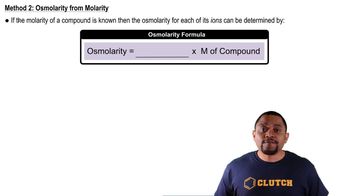
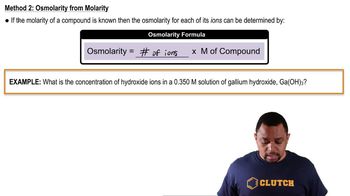
How can you determine osmolarity from the molarity of a compound?
Multiply the molarity of the compound by the number of ions it dissociates into to get the osmolarity.
Why is understanding osmolarity important in biochemistry and chemistry?
Osmolarity affects water movement through osmosis, influencing biological and chemical processes.