Periodic Table: Charges quiz #2 Flashcards
Periodic Table: Charges quiz #2
You can tap to flip the card.
Control buttons has been changed to "navigation" mode.
1/17
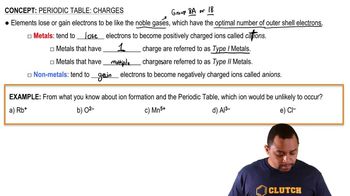
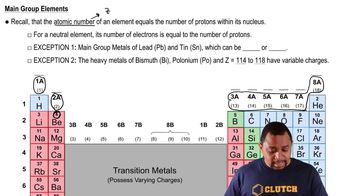
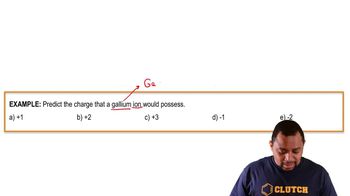
What is the charge on the magnesium (Mg) ion?Magnesium ion has a +2 charge.What is the expected charge of the elements in group IA?Group IA elements (alkali metals) have a +1 charge.Which element has the same number of energy levels as lithium?Elements in period 2, such as beryllium or boron, have the same number of energy levels as lithium.What is the most likely reason that Mendeleev placed tellurium before iodine?Mendeleev placed tellurium before iodine to maintain the order of elements by properties, despite atomic mass.Does any element with atomic number Z ≥ 92 match the description of a main group element?No, elements with Z ≥ 92 are actinides and not main group elements.Which element is the most reactive: sodium, nickel, carbon, or oxygen?Sodium is the most reactive among these elements.What did Mendeleev finally insert in order for the elements to make sense in their locations?Mendeleev inserted gaps for undiscovered elements to maintain periodic trends.Which element has the most protons?Oganesson (Og) has the most protons, atomic number 118.What are the typical charges for elements on the periodic table?Group 1A: +1, Group 2A: +2, Group 3A: +3, Group 5A: -3, Group 6A: -2, Group 7A: -1.Which period 3 metal is more reactive than magnesium?Sodium, a period 3 metal, is more reactive than magnesium.What is the charge of phosphorus when it forms an ion?Phosphorus forms a -3 ion.Is chlorine (Cl) a metal or nonmetal?Chlorine is a nonmetal.What is the charge of zinc when it forms an ion?Zinc forms a +2 ion.Do elements in the third period of the periodic table all have occupied energy levels?Yes, elements in the third period all have three occupied energy levels.Which group tends to form 1+ ions?Group 1A elements (alkali metals) tend to form 1+ ions.Where are cations found on the periodic table?Cations are formed by metals, which are found on the left and center of the periodic table.How is the periodic table arranged?The periodic table is arranged by increasing atomic number (number of protons).