Periodic Trend: Atomic Radius quiz #4 Flashcards

Periodic Trend: Atomic Radius quiz #4
Control buttons has been changed to "navigation" mode.
1/17
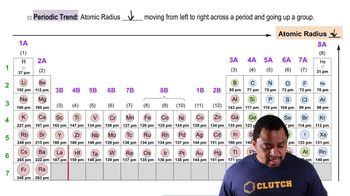
  • Which of these statements correctly describes a trend in atomic radii in the periodic table?

    Atomic radii increase down a group and decrease across a period.
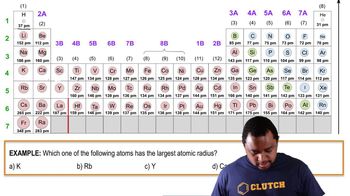
  • Which of the following elements has the largest atomic radius?

    Francium has the largest atomic radius.
  • Which of the following sequences corresponds to a correct trend in atomic radius size?

    Atomic radius increases down a group and decreases across a period.
  • Which of the following elements has the greatest atomic radius?

    Francium has the greatest atomic radius.
  • Rank the following atoms in order of decreasing size (i.e., largest to smallest): Rb, F, Mg, B, N.

    Rb > Mg > B > N > F
  • Atomic radii from the left to right across a period tend to: increase or decrease?

    Atomic radii tend to decrease from left to right across a period.
  • Atomic radii from the top to the bottom of a group tend to:

    Atomic radii tend to increase from top to bottom of a group.
  • Of the following, which gives the correct order for atomic radius for Mg, Na, P, Si, and Ar?

    Na > Mg > Si > P > Ar
  • The atomic radius of main-group elements generally increases down a group because ________.

    More electron shells are added.
  • The atomic size of atoms ________.

    Atomic size increases down a group and decreases across a period.
  • Rank the following atoms in order of increasing size (i.e., smallest to largest): Li, Al, Be, Ba, O.

    O < Be < Li < Al < Ba
  • Which periodic group has the smallest atomic radius?

    Group 18 (noble gases) generally have the smallest atomic radii in their periods.
  • Rank the following elements in order of decreasing atomic radius.

    Atomic radius decreases from bottom left to top right on the periodic table.
  • The trend towards smaller atomic radii as one moves to the right in a period is _____.

    Due to increasing nuclear charge pulling electrons closer.
  • Atomic radius generally increases as we move

    Down a group and to the left across a period.
  • Rank the elements highlighted in the figure based on increasing size of their atoms.

    Atomic size increases from top right to bottom left on the periodic table.
  • If the atomic radius of aluminum is 0.143 nm, what does this value represent?

    It represents the distance from the nucleus to the outermost electron shell in aluminum.