Back

Periodic Trend: Electron Affinity quiz

Control buttons has been changed to "navigation" mode.
1/15
  • What is electron affinity (EA) in chemistry?

    Electron affinity is the energy released when an electron is added to a gaseous atom or ion, usually measured in kilojoules.
  • Is the process of adding an electron to a neutral atom exothermic or endothermic?

    It is exothermic, meaning energy is released during the process.
  • What does a more negative electron affinity value indicate about an element's tendency to gain electrons?

    A more negative electron affinity means the element has a stronger tendency to gain an electron.
  • How does electron affinity generally change as you move toward the top right corner of the periodic table?

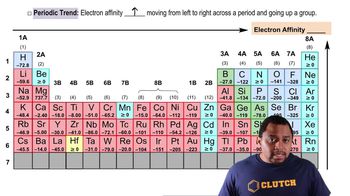
    Electron affinity generally becomes more negative, indicating an increase in exothermicity.
  • What does it mean if an element has an electron affinity equal to or greater than zero?

    It means the element does not readily accept an electron, often due to stable electron configurations.
  • Why do noble gases have electron affinities equal to or greater than zero?

    Noble gases have completely filled orbitals, making them stable and reluctant to accept additional electrons.
  • Which subshells are most stable when completely filled, affecting electron affinity?

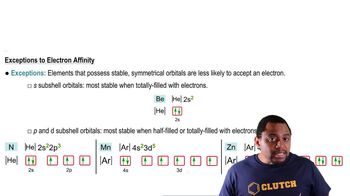
    The s, p, and d subshells are most stable when they are completely or half-filled.
  • Why does beryllium have an electron affinity equal to or greater than zero?

    Beryllium's s orbital is completely filled, so it does not want to accept another electron.
  • Why is nitrogen an exception to the general trend in electron affinity?

    Nitrogen's p orbitals are half-filled, making it stable and less likely to accept an electron.
  • What is the electron affinity trend for elements like zinc, cadmium, and mercury?

    These elements have completely filled d subshells, so their electron affinities are equal to or greater than zero.
  • How does the electron affinity of fluorine compare to that of hydrogen?

    Fluorine has a more negative electron affinity than hydrogen, meaning it wants an electron more strongly.
  • Why are the electron affinities of elements in the bottom row of the periodic table often not listed?

    These elements are very large and unstable, making their electron affinities difficult to measure or not meaningful.
  • What is the significance of a negative sign in electron affinity values?

    A negative sign indicates that energy is released when an electron is added, making the process exothermic.
  • Why does manganese have an electron affinity equal to or greater than zero?

    Manganese has half-filled d orbitals, which makes it stable and less likely to accept an electron.
  • How does electron affinity influence chemical bonding and reactivity?

    Electron affinity affects how elements form chemical bonds and react with each other by indicating their tendency to gain electrons.