Back

Periodic Trend: Ionic Radius quiz

Control buttons has been changed to "navigation" mode.
1/15
  • What is the definition of ionic radius?

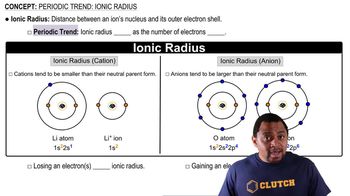
    Ionic radius is the distance from an ion's nucleus to its outermost electron shell.
  • How does the ionic radius trend differ from other periodic trends?

    Ionic radius does not follow the general top-right direction on the periodic table; instead, it depends on the number of electrons in the ion.
  • What happens to the ionic radius when an atom loses electrons to become a cation?

    The ionic radius decreases because the ion loses a valence shell, making it smaller than its neutral atom.
  • Why are cations smaller than their neutral atoms?

    Cations are smaller because they lose electrons, reducing the number of electron shells and decreasing electron-electron repulsion.
  • What happens to the ionic radius when an atom gains electrons to become an anion?

    The ionic radius increases because the added electrons increase electron-electron repulsion in the outer shell.
  • Why are anions larger than their neutral atoms?

    Anions are larger because gaining electrons increases repulsion among electrons, expanding the outer shell.
  • What is the general trend for ionic radius as the number of electrons increases?

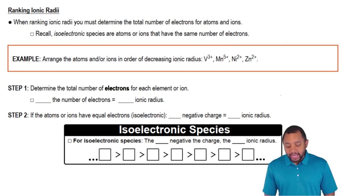
    As the number of electrons increases, the ionic radius becomes larger.
  • Does the periodic table position directly determine ionic radius?

    No, ionic radius is determined by the number of electrons, not by the element's position on the periodic table.
  • What is the electron configuration of neutral lithium and its cation?

    Neutral lithium is 1s² 2s¹, and lithium ion (Li⁺) is 1s² after losing one electron.
  • How does losing a valence electron affect the size of an ion?

    Losing a valence electron reduces the number of electron shells, making the ion smaller.
  • What is the electron configuration of neutral oxygen and its anion?

    Neutral oxygen is 1s² 2s² 2p⁴, and oxide ion (O²⁻) is 1s² 2s² 2p⁶ after gaining two electrons.
  • How does gaining electrons affect the size of an ion?

    Gaining electrons increases electron-electron repulsion, causing the ionic radius to increase.
  • What should you focus on to determine the trend in ionic radius?

    You should focus on the total number of electrons in the ion.
  • What is the relationship between electron number and ionic radius?

    More electrons result in a larger ionic radius.
  • Why is understanding ionic radius important in chemistry?

    It helps predict and explain the properties of ions in various chemical contexts.