Periodic Trend: Ionic Radius quiz #1 Flashcards

Periodic Trend: Ionic Radius quiz #1
Control buttons has been changed to "navigation" mode.
1/16
  • Which element has an ion that is smaller than an ion of calcium?
    An element that forms a cation with fewer electrons than Ca2+, such as magnesium (Mg2+), will have an ion smaller than a calcium ion.
  • How do ionic radii vary moving down a group?
    Ionic radii increase as you move down a group because each successive element has an additional electron shell.
  • Why is the sodium cation larger than the magnesium cation?
    The sodium cation (Na+) is larger than the magnesium cation (Mg2+) because Na+ has more electrons than Mg2+, resulting in a larger ionic radius.
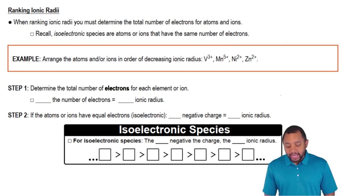
  • Which isoelectronic series is correctly arranged in order of increasing radius?
    In an isoelectronic series, the ion with the most negative charge has the largest radius, and the one with the most positive charge has the smallest. For example: Mg2+ < Na+ < F− < O2−.
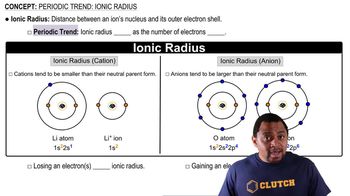
  • Describe the change in size when an atom becomes a cation.
    When an atom becomes a cation, it loses electrons, resulting in a decrease in ionic radius compared to its neutral atom.
  • Which of the following elements has the smallest ionic radius?
    Among a set of ions, the one with the highest positive charge and fewest electrons (such as Al3+ compared to Na+ or Mg2+) will have the smallest ionic radius.
  • Which period 3 element would have the largest ionic radius?
    Among period 3 elements, the anion with the most electrons, such as phosphorus forming P3−, would have the largest ionic radius.
  • What happens to the size of a nonmetal ion when it gains electrons?
    The size of a nonmetal ion increases when it gains electrons, forming an anion.
  • Does the radius of magnesium increase or decrease as it loses electrons?
    The radius of magnesium decreases as it loses electrons to form Mg2+.
  • Which ion has the largest radius: Ca2+?
    Ca2+ does not have the largest radius among common ions; anions with more electrons, such as S2− or Cl−, would have larger radii than Ca2+.
  • Which element is most likely similar to oxygen in that it will form an ion with a 2− charge?
    Sulfur is most similar to oxygen in that it commonly forms a 2− anion (S2−).
  • Consider two ions: Mg2+ and O2−. Which do you think is larger?
    O2− is larger than Mg2+ because it has more electrons, resulting in a larger ionic radius.
  • Consider two ions: Mg2+ and O2−. Which do you think is bigger?
    O2− is bigger than Mg2+ due to having more electrons and greater electron-electron repulsion.
  • What is the trend of ionic radius?
    Ionic radius increases as the number of electrons in the ion increases, regardless of position on the periodic table.
  • An element with the smallest anionic (negative-ionic) radius would be found on the periodic table in which location?
    An element with the smallest anionic radius would be found in the top right of the periodic table, such as fluorine forming F−.
  • Compare the atomic radii of a divalent cation and a monovalent anion.
    A divalent cation (e.g., Mg2+) will have a smaller ionic radius than a monovalent anion (e.g., Cl−) with the same number of electrons.