Periodic Trend: Ionization Energy quiz #3 Flashcards

Periodic Trend: Ionization Energy quiz #3
Control buttons has been changed to "navigation" mode.
1/10
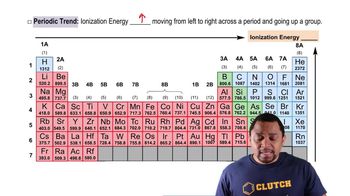
  • Ionization energy _____ across a period.

    Ionization energy increases across a period.
  • Ionization energies of elements _________ down a group and generally __________ across a period.

    Ionization energies decrease down a group and generally increase across a period.
  • Arrange these elements according to first ionization energy.

    Arrange elements from lowest to highest first ionization energy: bottom left to top right of the periodic table.
  • Rank the following elements according to their ionization energy.

    Rank elements from lowest to highest ionization energy: bottom left to top right of the periodic table.
  • Among the elements of the main group, the first ionization energy increases in which direction?

    First ionization energy increases from left to right across a period and from bottom to top within a group.
  • The first five ionization energies of a period element have the following pattern: what is the general trend?

    Each successive ionization energy is higher than the previous, as removing additional electrons requires more energy.
  • Arrange these elements according to first ionization energy.

    Arrange elements from lowest to highest first ionization energy: bottom left to top right of the periodic table.
  • Rank these elements according to first ionization energy.

    Rank elements from lowest to highest first ionization energy: bottom left to top right of the periodic table.
  • Why is the process of removing an electron from a gaseous atom considered endothermic?

    Because energy must be absorbed to overcome the attraction between the electron and the nucleus, making the ionization energy always a positive value.
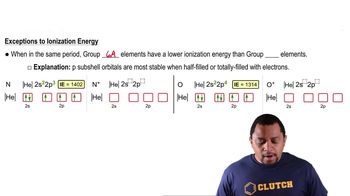
  • What is the reason for the lower ionization energy of group 3A elements compared to group 2A elements in the same period?

    Group 2A elements have fully filled s orbitals, which are more stable, so it requires more energy to remove an electron compared to group 3A elements, whose p orbitals are less stable when partially filled.