Periodic Trend: Metallic Character quiz #2 Flashcards
Periodic Trend: Metallic Character quiz #2
You can tap to flip the card.
Control buttons has been changed to "navigation" mode.
1/24
Which characteristic makes some metals important in electronic devices?
High electrical conductivity makes metals important in electronic devices.Which element is dull and brittle?
Nonmetals, such as sulfur, are dull and brittle.Which of these elements is most reactive: lithium, sodium, or potassium?
Potassium is the most reactive among these due to its higher metallic character.What type of elements are shiny?
Metals are typically shiny due to their luster.What is one property of metalloids?
Metalloids are semiconductors, having intermediate electrical conductivity.Which of the following elements is the most electropositive: sodium, magnesium, or aluminum?
Sodium is the most electropositive due to its high metallic character.Which of the following elements have the most metallic character: sodium, magnesium, or aluminum?
Sodium has the most metallic character.Which of the following is a characteristic of nonmetals?
Nonmetals are generally brittle and poor conductors of electricity.Which element forms easily into thin sheets?
Gold is highly malleable and forms easily into thin sheets.What is the most reactive element?
Cesium is the most reactive metal; fluorine is the most reactive nonmetal.Why do noble gases rarely react with other elements?
Noble gases have full valence electron shells, making them stable and unreactive.At which location in the periodic table would the most active metallic element be found?
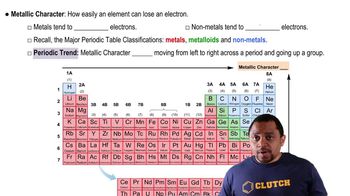
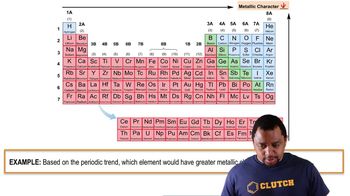
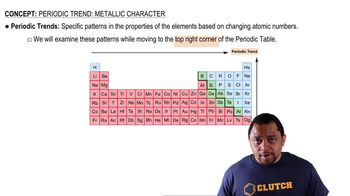
The most active metallic element is found at the bottom left of the periodic table.Which statement describes a characteristic of most metals?
Most metals are malleable, ductile, and good conductors of electricity.Which of the following is a property of most metalloids?
Most metalloids are semiconductors.Which of the following is a property of metals?
Metals are good conductors of heat and electricity.What happens to metal reactivity down a group?
Metal reactivity increases as you move down a group.In which directions does metal reactivity increase on the periodic table?
Metal reactivity increases from right to left across a period and from top to bottom down a group.Elements found to the left of the metalloids on the periodic table display which properties?
Elements to the left of the metalloids are metals, showing high metallic character.Would you normally expect neon (Ne) to form compounds?
No, neon is a noble gas and rarely forms compounds.Elements found to the right of the metalloids on the periodic table display which properties?
Elements to the right of the metalloids are nonmetals, showing low metallic character.Which element best conducts electricity: argon, copper, nitrogen, or oxygen?
Copper best conducts electricity among the listed elements.Which group has the greatest metallic character?
Group 1 (alkali metals) has the greatest metallic character.Choose the property that best predicts metallic behavior of elements in the periodic table.
The ease with which an element loses electrons best predicts metallic behavior.Does metallic element reactivity increase as you move left to right in a period?
No, metallic element reactivity decreases as you move left to right in a period.