Physical & Chemical Changes quiz #5 Flashcards

Physical & Chemical Changes quiz #5
Control buttons has been changed to "navigation" mode.
1/40
  • What makes physical properties different from chemical properties?
    Physical properties can be observed without changing composition; chemical properties involve changes in composition.
  • Is baking a cake a chemical or physical change?
    Baking a cake is a chemical change.
  • How is a chemical change different than a physical change?
    A chemical change forms new substances; a physical change does not.
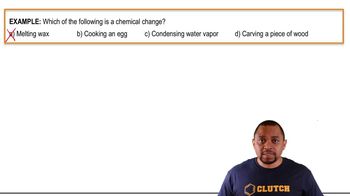
  • Example of a chemical change?
    Rusting of iron is a chemical change.
  • Why is boiling water a physical change?
    Because the chemical composition of water remains unchanged.
  • Which of the following is not an indication of a chemical change?
    Change in shape is not an indication of a chemical change.
  • Which of the following changes does not involve chemical reactions?
    Melting ice does not involve chemical reactions.
  • Which statements comparing physical and chemical properties are true?
    Physical properties do not involve changes in composition; chemical properties do.
  • Which of these are examples of chemical change?
    Burning, rusting, and cooking are examples of chemical change.
  • Which of the following would not be evidence of a chemical change?
    Change in physical state is not evidence of a chemical change.
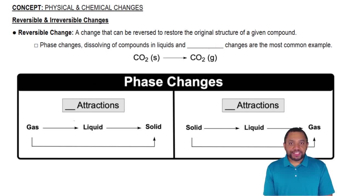
  • What change of state occurs during vaporization?
    Liquid changes to gas during vaporization.
  • Which is not a physical change of water?
    Burning hydrogen in water is not a physical change.
  • How might a chemical change be reversed?
    Most chemical changes cannot be reversed under normal conditions.
  • Which is the main difference between physical changes and chemical changes?
    Physical changes do not alter chemical composition; chemical changes do.
  • Is dissolving sugar in tea a chemical or physical change?
    Dissolving sugar in tea is a physical change.
  • Which of the following indicates that a physical change has taken place?
    Change in state or appearance without new substance formation.
  • Why is cooking an egg a chemical change?
    Cooking an egg forms new substances and changes its chemical composition.
  • Which of the following changes are chemical changes?
    Burning, rusting, and cooking are chemical changes.
  • Which of the following is an example of only a physical change?
    Melting butter is only a physical change.
  • Which of the following describes condensation?
    Condensation is the process where a gas becomes a liquid.
  • What happens during condensation?
    Gas particles lose energy and become liquid.
  • What happens during evaporation?
    Liquid particles gain energy and become gas.
  • What is an example of condensation?
    Water droplets forming on a cold window.
  • What happens to the molecules of a substance during a chemical change?
    Molecules rearrange to form new substances.
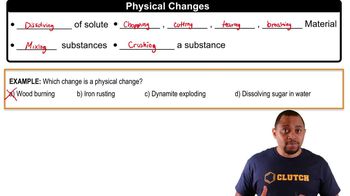
  • What is an example of a physical change?
    Cutting paper is an example of a physical change.
  • How can the appearance of a substance change without it becoming a different substance?
    Through a physical change, such as changing shape or state.
  • What changes in water as it shifts from a solid to a liquid to a gas?
    Its physical state changes, but its chemical composition remains the same.
  • What happens in condensation?
    A gas loses energy and becomes a liquid.
  • What happens to a substance during a physical change?
    Its physical state or appearance changes, but its chemical identity remains the same.
  • Which change of state is shown in the model?
    If a substance goes from liquid to gas, it is evaporation.
  • Which process is a chemical change: burning a match, boiling water, melting ice, or breaking glass?
    Burning a match is a chemical change.
  • Which of the following is an example of chemical weathering?
    Rusting of rocks is an example of chemical weathering.
  • Which laboratory activity involves a chemical change?
    Mixing vinegar and baking soda involves a chemical change.
  • Which is an example of a chemical change: frying an egg, boiling water, melting butter, or chopping onions?
    Frying an egg is a chemical change.
  • Which change of state is shown in the model: condensation, evaporation, sublimation, or deposition?
    If a gas becomes a liquid, it is condensation.
  • During which change of state do atoms lose energy?
    Atoms lose energy during freezing, condensation, and deposition.
  • Which statement describes a characteristic of deposition?
    Deposition is when a gas changes directly to a solid.
  • What happens to the atoms in a liquid as it freezes?
    Atoms lose energy and arrange into a solid structure.
  • Which of these most likely represents a chemical change?
    Burning wood most likely represents a chemical change.
  • Which statement best describes a physical change?
    A physical change alters appearance or state but not chemical composition.